Showing posts with label Veterans. Show all posts

Monday, January 14, 2013

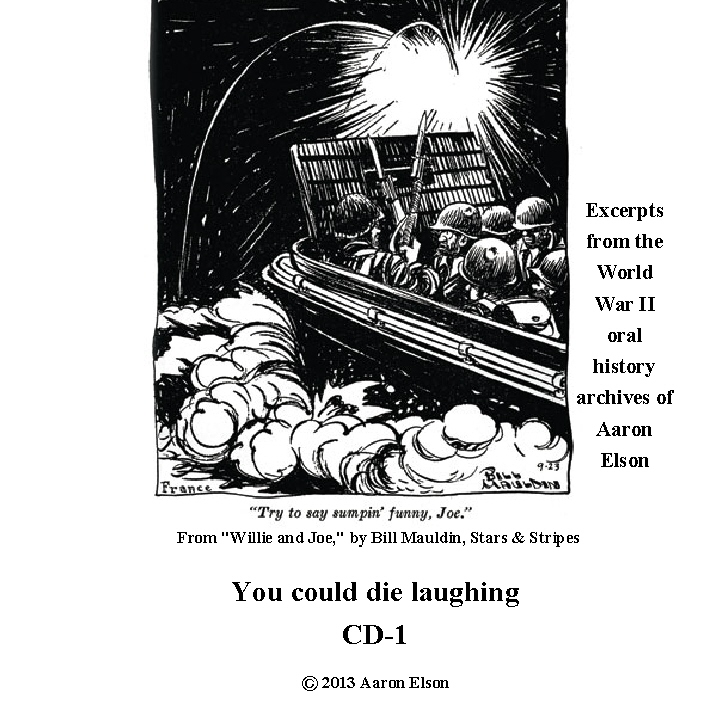
You Could Die Laughing

   Lately I've been putting together themed compilations of stories taken from my personal archive of some 600 hours of interviews with World War II veterans.
   One recurring theme in the interviews is the importance of a sense of humor to the combat soldier. Some things might not seem funny in retrospect, and others withstand the test of time, like the new lieutenant who instructs his company, "Hands on Place, Hips!"
   Bill Scheiterle was a young lieutenant in the assault wave on the island of Peleliu. "I don't ever have to worry about going to Hell because I've been there," he said when I interviewed him at the Eldred World War II Museum one Memorial Day. Then he told me an amusing story about one of the most horrific battles of World War II. He told his company that he had a bottle of brandy in his pack and when they got ashore he would break it open and they would all have a drink. However, a shell exploded nearby and as he lay face down on the beach, he heard one of his men shout "The lieutenant's been hit." Then he heard another voice shout "The heck with the lieutenant, get the bottle!"
   (Tragically, the bottle of brandy, along with Scheiterle's pack, was demolished, but the lieutenant was patched up on a ship and returned to action the next day.)
   Frank Bertram was a 19-year-old navigator when his B-24 was shot down during the ill-fated Kassel Mission bombing raid of Sept. 27, 1944. The Kassel Mission generated one of the great stories of closure to come out of World War II: In 1986 a monument was dedicated in Friedlos, Germany, with the names of all of the American and all of the German fliers (and a handful of civilians) who died in one of the most spectacular aerial battles of World War II. Some 600 people, including American and German survivors of the battle, attended the dedication. Afterward, Bertram was invited to a reunion of veterans of one of the German fighter squadrons that attacked the 445th Bomb Group that fateful day.
   The German veterans were boisterous, drank a lot of beer and smoked liked chimneys, and for a gavel, their president used the joystick of a Fokke-Wulf 190. Toward the end of the evening, Bertram asked to see the joystick that was used as a gavel. He turned it over, looked at its underside, and said "Hah, it says "Made in Japan."
   After a moment of stunned silence came the remark "Nein! Nein! Deutschland!" before his hosts realized he was making a joke, and burst out in laughter.
   These and many other stories, all of which are historical and some of which are hysterical, are included on the new audio double-CD, which is available in my eBay store, along with the many other audiobooks drawn from my oral history interviews.
   Mention the blog when you order a copy, and I'll include my other new individual themed CD, "Uphill Both Ways," with stories about the Great Depression. I'll have more about that in my next entry.
   Here are some excerpts from "You Could Die Laughing."

mp3 John Zimmer, a veteran of the 712th Tank Battalion, describes a visit to an elementary school.

mp3 Reuben Goldstein, a tank commander in the 712th, has a book autographed by a general. (From "Once Upon a Tank in the Battle of the Bulge")

mp3 Bob Hamant, a Marine who spent a year on the island of Tinian, describes an incident while unloading 90-millimeter shells from an ammunition ship. (From "Four Marines").

mp3 Frank Bertram, a navigator on a B-24 and former prisoner of war, tells of an invitation to a reunion of German fighter pilots. (From "The Kassel Cassettes," which is currently out of circulation while it undergoes some changes).

mp3 Bob Hamant recalls some playful goats on the island of Tinian that liked to pee on sleeping Marines.

NOTE: I produce these audio CDs from my personal oral history archives in small batches with paper labels. Because of this, it's important to keep them from excessive cold or heat, which could cause buckling of the label. It's recommended, if possible, to make a backup copy of each CD. Occasionally the CDs will skip in a car CD player while they play well in computers and regular CD players. I'm working on the problem, but if it should arise will make a full refund or send replacement CDs. Thank you, Aaron Elson

New in my eBay store:


Please visit the Oral History Audiobooks campaign


Tuesday, November 20, 2012

Southbound Winnie and Southbound Peggy


The B-26 on which tail gunner John Sweren flew 58 missions.

   When Stephen Ambrose wrote that he felt like he developed post traumatic stress syndrome just by interviewing all the World War II veterans that he did, I thought, "What a crock." But I can understand where he was coming from, and I'm sure he was exaggerating a bit. And while I would never claim to have anything close to PTSD, some of the interviews I've done are veritable emotional roller coasters, going from laughing out loud to getting all choked up and vice versa.
   One such interview is the subject of my new Kindle publication, "Merry Christmas in July," an edited transcript of my conversation over two days in Mesa, Arizona, in 2009 with John Sweren.
   John's B-26 took a direct hit on July 28, 1944, and the tail section broke off with him in it. He managed to bail out, was captured and became a prisoner of war. One of the stories he told was how in Stalag Luft IV, he read a book called "Ordeal by Hunger," about the Donner party. Most of the other people in his room in the prison compound read it as well. When he was on the long POW march across Germany in February and March of 1945, he was so hungry one night that before going to sleep he told his buddy Lloyd Alexander that if Lloyd should wake up in the morning missing an arm or a leg, he'd know where it went. He meant it as a joke, but when he woke up his buddy was nowhere to be found, and he never saw him again. That should be humorous, but it always haunted John that his friend must have taken him seriously.
   John tells the story better than I do, which is why, when possible, I prefer to present the stories I record in the veterans' own voices or in their own words.
   The audio of John's interview is available from audible.com in a three-interview set titled "March Madness," and now the transcript is available from Amazon for its Kindle e-book reader.
   Here's an excerpt:

Aaron Elson: What about the first time you shot down a German fighter?

John Sweren: First time? I think it was an ME-109. They circled, and I opened fire before he did, and whether he fired or not I don’t know. I couldn’t tell you, there was so much debris in the air there when I hit it, and I didn’t know whether I hit it but they claimed I did, because in a box, you have six planes, three up here and three a little bit lower. So I’m not the only one that’s got a gun. Other people see the plane also. But that’s why I got a couple planes shot down and one probable. But when the plane was hit that I thought I hit, they claimed I hit it, and it just flipped over and down it went.

But, this is not my idea, on a .50-caliber machine gun there’s a buffer plate on the back with a cylinder on the buffer plate, probably two inches long or two and a half inches long, a Micarta disk, plastic kind of, so when the bolt would come back for the recoil – this was none of my idea but somebody said well, they put nickels in there. So I got some nickels from home, I sent for them. I put them in there, and every fifth bullet is a tracer, okay, when you shot, it looked like all tracers. The recoil was three times as fast with the nickels in there, because we’d come back sometimes, my boxes were almost empty.

Aaron Elson: So it would speed up the rate of fire?

John Sweren: Yes.

Aaron Elson: So the tracer was almost constant.

John Sweren: Yes. And I was, I don’t know who told me this, nobody followed up on it but I did, and my crew chief says, every time we came back he’d change the barrels, he says, it looks like a shotgun, no land and no grooves in there.

Aaron Elson: Because the heat was melting the ...

John Sweren: I didn’t know what it looked like too much in the daylight time, but one evening we had a late mission, and boy, I’ll tell you, in the dark, it looked like every bullet was a tracer. But that was my experience. Everybody didn’t do it but I did it, because somebody told me to put nickels in there, so I sent home to the United States and they sent me three rolls of nickels. I think I gave some to somebody else.

Aaron Elson: Would you have to replace the nickels?

John Sweren: They stayed in there all the time. The Micarta disk looked like kind of a rust color, about the same size as a nickel, but evidently there was some sponge there, give there, nickels, snap, snap, snap, so I know every mission the crew chief would check the barrels, wanted to know if I used it.

Aaron Elson: Now you had two kills and three probables, no?

John Sweren: No, I think two kills and one probable.

Aaron Elson: What was the second one like?

John Sweren: The second one was, we were, we always flew different boxes, had three boxes, you’d have a high box, a middle box and a lower box. The lower box was kind of a Purple Heart box. And I think the second one we were in the low box, and the plane kind of circled. I lost track of it, and it came up from kind of underneath and made a 90-degree turn and started firing. Of course my rapid fire I think got him, but he just, just a flash of light, that’s all, I couldn’t tell, I blew it up. But, uhh, but after that happened, I said a little prayer, God bless the guy, he was in the war just like I was, fighting for his country, and I felt sorry for what happened. It was either him or me. Or us.

Aaron Elson: Even though he was trying to kill you, you didn’t feel anger?

John Sweren: Well, I guess I felt anger at the time, but after it exploded, the anger went away and I felt sorry for him and his family, or loved ones. That was me mostly, I don’t know what the group that I was in, my acquaintances, my crew, and even other people that were on different aircraft, after the briefing, the woman pours drinks for you and then, at first I thought boy that’s got to be cocktail hour. They had a purpose for it, to loosen you up and you’d talk. But get to the barracks, and communications was very, we hardly ever talked about what happened. The people in my barracks, everybody kind of talked about something else. We played a little cards, we’d play on this guy’s bed, and we had some plastic cups there and we’d have a drink. Not everybody drank, but I did, quite a bit. Well, I came from a family that, we always had booze on the table and milk, nothing else, and my father said “Take your choice,” but I never drank anything until after the war. I didn’t know what liquor did to you but it does relax you. It put me to sleep a lot of times, because I’d have two or three drinks, and you could feel it, so I’d sleep pretty good. If I didn’t have anything to drink I’d toss all night, and dream about this and that.

Aaron Elson: You’d dream about the missions, in England?

John Sweren: Yes.

Aaron Elson: Now tell me about the time, Brett was telling me outside, that you had a couple of drinks and you fell asleep in a shelter and you woke up and the roof had collapsed on top of you, in London.

John Sweren: Well, it was not in a shelter, it was a house. This was in Rumford, England, probably around 75 kilometers from the base. I rode my bicycle that far. Seventy five kilometers is a guess on my part. So you’d see a sign in this yard, “room for rent.” I saw two of them and I saw this bigger house. I rang the doorbell or knocked, and they said yes, come on in. I introduced myself. Then I went kind of into Rumford, and I think into London maybe, London I think it was, and they had dog races. And all these guys up there, well, you’ve got to bet on so and so and so and so. I had a little paper there, a program, of the horses, I mean the dogs that were running, so I went up there. I already picked them out, Southbound Winnie and Southbound Peggy. I chose Southbound Winnie to come in first and Southbound Peggy to come in second, and it was just the opposite. They both came in. And, I don’t know, at that time the British pound was $4.05 US, so I had a whole sack full of money. They had a bar there, and of course I was drinking, and there was a flower shop. Before I got there I bought some flowers to take to the place where I was staying. There were two ladies there, a grandma and her daughter. So I bought flowers for them. Oh, they’ve got a tub there, I put the flowers in this tub. So after the race, I went to the counter and got my money, I don’t know how many pounds I had but quite a bit, maybe about four hundred dollars worth, so I got on this bus, and from the bus I got a cab, and I was pretty loaded.

I stumbled into the house there, and I brought the flowers in. On the way up the stairs, they had a beautiful vase, I knocked it down and broke it. And I said, “Ohhhh, I’m so sorry.”

“That’s okay. That’s okay.”

So they took me into bed, brought me some tea and some little cookies, and I passed out. Boy, I’d drank quite a bit, or it hit me a lot. So morning came, and I felt like there was lead on top of me. I opened my eyes, and I see daylight through the roof. It was all plaster on me. A buzz bomb had exploded nearby. How I made it I’ll never know, but after it was all over, the two ladies, I think one was 72 and the daughter was fifty something, she’d lost her husband in the war, so they thought I was gone because when they escaped out of the house, well, after it was all over there’s a little blank there in my mind, but when they came back, she said, “Johnny, the vase would have been broken anyhow.” She said “I’d sooner have you break it than doggone it, the Krauts.”

   (With special thanks to Christian Levaufre and Brett Schomacher, both of whom made my interview with John Sweren possible)

- - -
"Merry Christmas in July" is available in the Amazon Kindle store. If you order it, please think about leaving a review.
John Sweren, center, at the dedication of a monument in 2005 where his plane crashed in Fierville-Bray, France.


- - -


From Oral History Audiobooks:
From Chi Chi Press:
Got Kindle?


Please help Oral History Audiobooks grow


Monday, September 24, 2012

Darrell Petty Part 2: The Death Camp Doctor

Klaus Schilling

    At the 1997 reunion of the 90th Infantry Division, I met Darrell Petty of New Castle, Wyoming. My tape recorder missed the beginning of our conversation, but at the start we were talking about the crossing of the Moselle River in November of 1944. The river was at flood stage, and the infantry crossed before the heavy equipment, including the tanks of the 712th Tank Battalion, could cross on a bridge. The fighting was intense, and the infantry was at risk of being pushed back into the river when the tanks finally did get across and helped to turn the tide of the battle.
From there the conversation turned to the division's second crossing of the Moselle River, in March of 1945. Initially I made two separate stories in Darrell's words out of this interview, but here I'll post the interview itself, with a brief postscript. (See Darrell Petty Part 1: Machine Gun Hill)

Darrell Petty
Omaha, Neb., Sept. 1997
 Aaron Elson: Were you wounded?
Darrell Petty: I was wounded twice, actually three times. Once I didn’t even, the line medic patched me up and that was it.

Aaron Elson: Where were you wounded?

Darrell Petty: Just outside of Chambois, when we closed the Falaise Gap, the first time. The second time I got it was in the Siegfried Line. And the third time that I got a minor wound was about two weeks before the end of the war.

Aaron Elson: And where was that?

Darrell Petty: Getting pretty close up to Czechoslovakia. I don’t remember just where, what town.

Aaron Elson: Before the liberation of the concentration camp?

Darrell Petty: After we went to Flossenburg.

Aaron Elson: Were you with them at Flossenburg?

Darrell Petty: Yeah. Flossenburg was the last one that we took. You won’t find it in the books or nothing, but the 4th Armored and part of our unit went to Buchenwald, too. But you won’t find it in any history book, because we were stopped at Merkers, where the gold reserves were. And Patton said it doesn't take us all to watch Merkers, and there was a little place called Ohrdruf or something like that. It was supposed to be a work camp. But we got there and there were bodies stacked up. A lot of them had come from Buchenwald. They were stacked up. First encounter. And we went to Buchenwald. The Germans were gone, the prisoners had apparently taken Buchenwald over by that time, but we saw what was there. And of course, that old camp commandant’s wife, she was called the Bitch of Buchenwald, because she liked tattoos, she made lampshades.

Aaron Elson: Ilse Koch?

Darrell Petty: Yeah, I guess. I don’t know, I don’t remember her name, I just called her what they called her. But anyway, the one unit...

Aaron Elson: Were you with that unit?

Darrell Petty: Yeah. And we went to Buchenwald, but you don’t find it.

Aaron Elson: Had Buchenwald already been liberated?

Darrell Petty: No. But the Germans knew we were going to overrun it and most of them had fled, and they took quite a lot of the prisoners from Buchenwald to Flossenburg. Then they tried to take them from Flossenburg to Dachau. So, like I said, most of the Germans were gone and the prisoners were actually about in charge of Buchenwald when we got there. But it was still in enemy territory at the time.

Aaron Elson: So you actually went to Buchenwald before it was liberated?

Darrell Petty: As it was liberated. The 4th Armored and a unit from our outfit and another outfit.

Aaron Elson: Did you go into it?

Darrell Petty: Oh yeah, we went in there.

Aaron Elson: And what did you see?

Darrell Petty: Bodies. Everything you can imagine. It horrified us, and we’d seen those bodies at that other one, I couldn’t say its name, and most of them had come from Buchenwald, so we were kind of prepared for it, but still it was...

Aaron Elson: Were any of the German guards captured at the time?

Darrell Petty: The prisoners had got some of them. The prisoners had killed some of them, they caught them, they killed quite a few, the ones that hadn’t got out of there. Once they got control, they went hunting. A revenge thing, and I couldn’t blame them. But where they were shipped to, down there at this other place, they had heavy equipment there and they were supposed to have dug trenches and got them buried before we got there, and they didn’t get it done.

Aaron Elson: And it was just the emaciated bodies?

Darrell Petty: Yeah, I’ve got a few pictures at home. So many times you’d take pictures. I got ahold of a camera, and you always got a moment to stop and snap a picture. We’d have to cross a river or something, you’d get the film wet, it was the old roll type, 120s and that. I’d have had more than I got. I’ve got some from Flossenburg, and Dachau.

Aaron Elson: Did you take any at Buchenwald?

Darrell Petty: I took some, but I lost them, before I got it. And then, after the war was over, I was still enlisted for a while. I enlisted, and instead of coming home with the division, I stayed over there in the army of occupation and they transferred me back to Munich, and I was attached to the 508th MP battalion in Munich. And when we weren’t doing the other stuff we just pulled regular MP duty. But we were at Dachau, at the war crime trials, and at Nuremberg, we were part of them.

Aaron Elson: Were you at Dachau for the war crimes trials? You never ran into a fellow named Clifford Merrill, did you? He retired as a colonel, but he had been a captain, but he was in charge of MPs at the Dachau...

Darrell Petty: I probably saw him, but you know, so many times, like I said, we didn’t know names. Didn’t bother with names. And if you didn’t know the guy, why, he was just another GI. I most likely saw him, I probably saw him there.

Aaron Elson: He was an officer of the MPs. He had contact with that Ilse Koch, and also there was one famous prisoner there, Otto Skorzeny, he was the commando who tried to capture Eisenhower, and who had freed Mussolini the first time, he was one of the prisoners there.

Darrell Petty: I don’t remember the name, but, you know, one that stands out in my mind was old Dr. Schilling.

Aaron Elson: Why does that stand out?

Darrell Petty: Because he did so much experimenting on the people and that, you know, he was the camp doctor...

Aaron Elson: At which camp?

Darrell Petty: Dachau. And he experimented on those people. Even when we took those places it was horrible to see what was there, but we still didn’t know about all the experimentation until the trials. And, uh, I come within an inch of shooting him.

Aaron Elson: Really?

Darrell Petty: That’s one of the reasons he stands out, I guess. Because we’d just been on his case, and I wasn’t at all the trials of Dachau, because they switched us back and forth. But we had some guys that had never seen an ounce of combat, who came over there later. And we had one new guy in there, and I won’t mention no names, I don’t want to implicate anybody, but anyway, he’d never seen combat. And he had a little .30 carbine, that was just semiautomatics at that time, and 15-round clips. But there would be a clip in the gun, and two clips on the butt of it. That’s 45 rounds. Okay. He’s standing there gawking around and he wouldn’t be protecting that gun. I got on him several times. I told him, "You protect that firearm." I said, "These guys don’t have anything to lose." Well, these guys that lived such a high muckety-muck life, it was kind of satisfying to see them sniping cigarettes off the floor, and they were eating some pretty thin soup that we brought for lunch, and they were in a soup line. That day it was some pretty thin soup. And this kid was standing there gawking around and he’s got the butt of the rifle grounded on the floor, and gawking around and not looking at them at all, he was looking around. And I just about went over and said something to him and I didn’t. And by golly, old Schilling was in line, and I, I just loathed him for what he’d done to people. And all at once he made a dive toward this kid, and the first thing flashed in my mind was he’s going for that carbine. I had a .45, and I always had it full loaded, the hammer on half-cock and the safety on. And he dove like he was reaching for that rifle. Well, as it turned out there was a cigarette butt about that long, boy, that was a prize, between that kid’s foot and the butt of the rifle. That’s what he was going for. But I didn’t know that. And I grabbed the old ‘45 and I dropped the safety, and cracked the hammer full, and when he came up with that cigarette, I was about from here to there ...

Aaron Elson: About six inches?

Darrell Petty: That half-hole looks awful big.

Aaron Elson: From his face?

Darrell Petty: And he just drained, his color just drained. "Oh, nein! Nein! Bitte! Bitte! Zigaretten, Rauchen! Rauchen! Bitte, nicht schiessen!" Don’t shoot, you know. Please. Rauchen is smoke. I never had a feeling like that in my life, before or since. But I wanted to pull the trigger. And I couldn’t hardly keep from pulling the trigger. And I finally just pushed my finger off of it. And I dropped the safety on, and I grabbed him and boy I throwed him back in the line and I told him to stay there, and he’d complained to me before about having to go to the bathroom a lot of the time, he’d had surgery, I suppose, prostate, I don’t know. But anyway, I thought, "Yeah, you, I sure feel sorry for you, you ..." And when I got done, I was mad. I throwed him in that line, and I done a pirouette and I kicked that kid just as hard as I could kick him right in the hind ...

Aaron Elson: The kid, the other MP?

Darrell Petty: Yes. And he lost his grip on the rifle and I grabbed that before it hit the floor, and he went down. And I stood above him, I had that butt of that rifle right in his face. And man, I told him in no uncertain terms what I’d do to him if I ever saw him, and I said, "Much as I wanted to do it, you almost made me kill a man without a reason." And I was just hyper, I was just, you know...

Aaron Elson: About how old were you at the time?

Darrell Petty: Nineteen. I went in at 17. And I was overseas at 17.


Aaron Elson: How’d that happen?

Darrell Petty: Well, my folks signed for me to go in, and when my unit shipped overseas, they didn’t say I couldn’t go, and I didn’t tell them I wasn’t supposed to go, and I went. I left New York in January of 1944 and was in England seven days later, well in Scotland seven days later. And then I went down by Cardiff, and the 90th hadn’t got there yet. I was assigned to the 90th about the middle of April. But I’ll tell you what, from that time on that kid was like this, he was looking at everything, with that carbine. I never saw him even look like he was gonna put it down after that. I could have got courtmartialed, I suppose, but at the time it did not matter. I was mad. I said, "You didn’t only pretty near make me kill him," I said. "He had nothing to lose. He could have grabbed that little carbine and started spraying us." It’s a pretty deadly little weapon at close range, I’ll tell you.

Aaron Elson: How old was this Dr. Schilling?

Darrell Petty: Probably middle age. At the time he looked quite old to me, but you know, they do when you’re young like that.

Aaron Elson: Was he executed, or what happened to him?

Darrell Petty: I don’t know whether they executed him or not...


(Coming soon: Darrell Petty, Part 3)


Got Kindle? My book "Tanks for the Memories" is available for a free download today (Sept. 25) only, a savings of $3.99 over the Kindle price and $13.95 over the print price. And I sure could use a couple of reviews at amazon, where a disgruntled reader just gave it a measly one-star review, and another gave it two stars. Phooey. If you enjoy reading these blog entries, which are similar to the source material in my books, I hope you'll make your enthusiasm known via a review at amazon. Thank you, Aaron

Postscript: According to testimony at the Dachau War Crimes trials, Dr. Klaus Schilling conducted malaria experiments on 1,200 inmates at Dachau. He was convicted and sentenced to death by hanging. The sentence was carried out in 1946.

- - -
From Oral History Audiobooks:
From Chi Chi Press:
Got Kindle?
 

Tuesday, July 10, 2012

Five D-Day Veterans Talkin' "Saving Private Ryan"


   Sometimes in an interview or conversation I'll get what might be called a little bit of ancillary history, one historical episode, that is, connecting with another.
   For instance, when I was transcribing my interview with James Finn, a veteran of the 294th Combat Engineer Battalion, I was somewhat agitated by the fact that Jim's wife was in the next room talking on the phone. And talking on the phone. And talking on the phone. And the tape recorder was picking it up as background noise, causing too great a distraction for me to use the interview in one of my original oral history audiobooks. To further exacerbate the situation, Jim's wife was not only talking on the phone through much of the interview, she had either a television or radio turned on.
   And then, during a lull in the interview, I could hear more clearly the sounds coming from the next room, and I realized that the TV or radio was broadcasting a basketball game. Not only that, but it was a New York Knicks playoff game. One minute while transcribing the tape I was frustrated as heck, and the next I was thinking, a Knicks playoff game, how cool is that!
   Or the time I was visiting Forrest Dixon at his home in Munith, Mich., around the time of his 80th birthday, and all over the television was the scene of a fallen Ranger being dragged through the streets of Mogadishu, which upset Forrest terribly. And just by happenstance it was around the first anniversary of the 9/11 attacks that I interviewed Nick Paciullo, a 4th Marine Division veteran of Iwo Jima, and he spoke at length about the episode of post traumatic stress that anniversary brought about.
   When I interviewed a group of veterans of the 299th Combat Engineer Battalion in Ithaca, N.Y., in 1998, "Saving Private Ryan" had recently been released. Sure enough, the subject came up in conversation.
   
Jim Burke: The actual D-Day scene was noisy, that’s all I can remember. I don’t remember anybody saying anything I could hear.

   Chuck Hurlbut: He tried to make it (“Saving Private Ryan”) that way because that’s the way it was.

   Jim Burke: That’s what I’m saying, it’s pretty typical. That’s what was so authentic about it, that’s all.

   Chuck Hurlbut: The first half hour. If anybody asks me I say the first half hour was true ...

   Tony DeTomaso: But the rest was all Hollywood after that.
  
   Chuck Hurlbut: I was so sad he got killed. I thought he’s a good egg. If it was a Hollywood film, he would have come home a hero.
  
   Jim Burke: Yeah, but did you notice, he had to put his captain’s bars on his helmet. That’s Hollywood too. Most guys took those emblems off real quick.

   Chuck Hurlbut: I remember seeing a lot of them.

   Jim Burke: Before the invasion or after? During the invasion you didn’t. They took them off.

   Bill Secaur: You know that Ryan, you remember, he’s from Syracuse, his cousin.

   Jim Burke: Tommy Niland. We had him at our 50th anniversary.

   Bill Secaur: That’s right. From Syracuse.

   Jim Burke: He was in the 101st Airborne and was a cousin of the real life Ryan.

   Jim DePalma: The real family was from Buffalo, right?

   Jim Burke: Tonawanda. And this guy was too. Tommy Niland was basketball coach at LeMoyne College for 25 years, maybe.

   Chuck Hurlbut: I thought it was so impressive, what really got me, it opens up in the cemetery with the old guy, then at the end, he becomes ...

   Jim Burke: That was pretty clever.

   Chuck Hurlbut: This is Private Ryan as an old man. Then at the end you saw the young guy. Now tell me, any of you guys ever hear Fubar?

   Jim Burke: No.

   Chuck Hurlbut: Fouled up beyond all recognition. They used it in the movie.

   Jim Burke: Maybe the Rangers had it.

   Chuck Hurlbut: I can’t find a guy that ever heard it. I never heard it. We had snafu. You heard that every ten minutes.

   Tony DeTomaso: What was the name, fubar?

   Jim Burke: F-U-B-A-R

   Tony DeTomaso: Yeah, but that’s just the initials. Well, you know what they were saying, don’t you? He just told you.

   Chuck Hurlbut: Fouled up beyond all recognition. Like a snafu. Situation normal all fouled up.

   Jim Burke: That’s why they had that little clerk guy running around trying to find, he’s an interpreter for Germany, he says “I never heard a German word like fubar.”

   Chuck Hurlbut: I never heard it.

   Jim Burke: Nobody did. It might have been a Ranger thing.

   Chuck Hurlbut: Now another thing about it. One of the guys gets hit. He’s laying out there and they’re all putting sulfa on him. Then they take the canteens and they wash it all off.

   Jim Burke: Getting the blood off.

   Chuck Hurlbut: Why wouldn’t that wash the sulfa off? I couldn’t understand that.

   Jim Burke: It probably did.

   Chuck Hurlbut: Every five minutes, washing him off and putting sulfa. I can’t understand that.

   Jim Burke: It was dramatic, wasn’t it? That’s the idea.

   Chuck Hurlbut: Yeah, but it seems so foolish, put the sulfa then wash it.

   Jim Burke: Yeah, but when you’re trying to simulate combat it’s all screwed up.

   Chuck Hurlbut: I guess.

   Jim Burke: Everybody’s excited.

   Bill Secaur: Actually, what we took off the boat, it never showed them taking little boats off the landing barges either in that movie.

   Chuck Hurlbut: Well, they couldn’t do everything.

   Jim Burke: You didn’t see any engineers, though, either. Did you notice, those obstacles were up in the water pretty good. This is after the tide’s come in. Quite a bit later. this is the third or fourth wave.

   Bill Secaur: You know what I can’t understand? Why they give the combat infantry badge just to the infantry. You know, we did a lot of infantry work.

   Chuck Hurlbut: We should have that. Or its equivalent. The medics got it.

   Aaron Elson: I can’t imagine the combat engineers not getting combat infantry badges.

   Jim Burke: I don’t think we should, though.

   Tony DeTomaso: Why?

   Jim Burke: You can’t compare your little infantry stint with a guy who’s been there for 30 days in a ...

   Tony DeTomaso: We didn’t get the credit we should be getting.

   Jim Burke: You don’t deserve a combat infantry badge either. That’s their thing.

   Chuck Hurlbut: When the infantry guy in the rear echelon back in Paris gets it ...

   Jim Burke: That’s their problem.

   Chuck Hurlbut: I want it.

   Tony DeTomaso: Look at the glider pilots. They didn’t get no jump ...

   Jim Burke: No, but they got a pin. There’s a combat engineer’s badge, probably. I don’t know.

   Chuck Hurlbut: There should be. There is none to my knowledge, but there should be.

   Tony DeTomaso: We did a lot of infantry work.

   Jim Burke: What, a day, two days?

   Bill Secaur: Regardless, you’ve got to build bridges and be the last one out and blow them up, too.

   Chuck Hurlbut: How about the Prum River? We’re down putting the damn footbridge, the infantry’s lolling up on the bank waiting for us. They’re all getting the combat infantry badge. I’m not.

   Jim Burke: No they’re not, not for that. Thirty days on the line. You talk to the guys up there at Aachen, when they can’t talk straight, their eyes are bugging out of their head, they’re so damn tired and disgusted, they’re the guys that deserve the combat infantry badge.

    Tony DeTomaso: They deserve it, no question about it, but so do we.

   Jim Burke: You know what happened to us up at Aachen? They were posting signs, one mile, two miles, six miles. All of a sudden these guys stopped us. They were the 1st Division. That’s their blockade. Their roadblock. They said “You can’t go in there.”

   I said “Why?”

   They said “We haven’t taken it yet.” And we’ve got signs, we’re supposed to go down in the middle of town and then start out.

   Bill Secaur: That movie with Telly Savalas where he was a tank guy, the guy was dressed like an American soldier and he was German, and all of a sudden they asked him a question, and right away Telly Savalas, he knew darn well the guy was lying. And he changed the signs around.
   Jim Burke: They said “You can go in there if you want to, but until they come back, we don’t know what’s down there. And those guys were excited, those infantry men are terribly distraught. I couldn’t get any sense of them.

   Tony DeTomaso: Most of them are replacements.

   Jim Burke: And they’re just like the cartoons, grizzly and dirty and they haven’t been anyplace except in that friggin line, and they’re sick. They’re really sick. It’s a wonder they don’t shoot each other.

   The full conversation, and several others is available in my new book, "Conversations With Veterans of D-Day," which is currently available in a Kindle edition only. I hope to have a print edition soon.


- - -
http://www.oralhistorystore.com

Check out some of the audio from the Oral History Store:


From Chi Chi Press:


Got Kindle?


Wednesday, June 6, 2012

D-Day 2012

A photograph by Robert Capa of the D-day landings in 1944. Photograph: International Center of Photography/Cornell Capa/Magnum 


   The following is an excerpt from my book-in-progress, tentatively titled "Conversations With Veterans of D-Day." I interviewed Valentine Miele, of Palisades Park, N.J., in 1994, shortly before the 50th anniversary of the invasion of Normandy. "Conversations With Veterans of D-Day" is a sequel to "A Mile in Their Shoes: Conversations With Veterans of World War II," whose e-book edition for Amazon's Kindle has ranked consistently on Amazon's bestseller list in its category (History...military...U.S....veterans) for the past three months.

   Valentine Miele was a machine gunner in the 1st Infantry Division, the fabled Big Red One.


Aaron Elson: Which regiment were you with?

Valentine Miele: I was with the 16th.
I’m going to England in two weeks. I’m leaving the 26th, back to where we were. I’m not going to France. I could go. I’d have to get a special pass to get onto the beach. I was there on D-Day, now I’ve got to get a special pass, so I said to hell with it.

Aaron Elson: You’re the first person I’ve talked to who was on Omaha Beach. What was it like?

Valentine Miele: It was rough when we got there. I was sick as a dog going in. Puking up.

Aaron Elson: What kind of a ship did you go in on?

Valentine Miele: An LCVP.

Aaron Elson: You crossed the channel on what?

Valentine Miele: On the Chase, an invasion ship. Then we had to climb down a cargo net. I was a machine gunner then. I lost the front side of my machine gun on D-Day, somebody chopped it off. It had to be another machine gun. I don’t know if you’ve ever seen an air-cooled machine gun, there’s a jacket around the barrel, and it has holes, so the air gets in there. And they hit that. It knocked the front side off my machine gun. I lost two fronts on my machine gun. And I lost a box of ammunition too, that day. You see, the gunner only carried the tripod. The assistant gunner carried the gun. The tripod I had tied to my wrist, with a rubber life preserver. When I got off the landing craft, when they dropped that gate, my company commander went off before me, but he was 6-6, he was a giant. When I went off the water was only up to my chest. I took two or three steps, and my feet didn’t touch the ground anymore. So I let go of the box of ammunition, because I had that in my left hand. In my right hand I had the tripod, that was tied, and I started to swim. When I started to swim, I thought I was swimming, the water was deep. I looked over to the side, there was my first sergeant, he was walking, and the water was only up to here. That’s when I got my foot down on the sand, and I took off for what we called the rock pile. Right at the edge of the water they had all crushed stone, so the water wouldn’t go in. Then behind that, they had a big hole they had dug, so if any water went over that it went in there, and the water coming off the hill went in there. That was a slop.

Aaron Elson: Was it high tide or low?

Valentine Miele: Low tide. They hit at low tide. Good thing. They had it planned right. At high tide we would have lost more. I don’t think we would have made, it because we wouldn’t have no beach to stand on. High tide it would have gone right up to the crushed stone, and they wouldn’t have seen those, have you ever seen the pictures with the railroad tracks up like that? They would have ripped the hell out of the boats. And then you see those big poles in the water? They had mines on top of those. So at high tide we would have hit them. I think they had it figured the high tide came up about a foot every ten minutes or so. And that water, it was rough. They were gonna call it off but it was rough. I’m glad they didn’t call it off. The day before we got in there, they moved a whole division in there for maneuvers, the 4th or 5th of June they moved a whole infantry division in, and we ran right smack into them. We lost a couple of men there. I think I got a couple. When we got on the beach we met a lieutenant that used to be with us in Sicily. We met him. “Hey, Lieutenant, how ya doing?” Some guy came running up and said, “Lieutenant! Lieutenant! The machine gun up there is cutting the hell out of G Company, cutting C Company apart.” So my sergeant says, “Miele, get on the gun.” I got on the gun. I set the gun up, and we’re looking, we’re looking. He says, “See if you can spot him.” All of a sudden I spotted him, about 200 yards away, and I’d say maybe about thirty or forty feet higher than me. He wasn’t firing at me. He was firing down across. So when he opened up again, the Germans, when they fire, they fire fast, they don’t fire like we did, because they change the barrels of their machine guns in seconds, ours were a pain. We had to take the whole gun apart and screw the barrel off, and then put another barrel on.
They would get hot if you fired like the Germans. We only fired bursts of three or four at a time. The Germans put their finger down, they’d run a hundred off. Because they just push a button, the barrel falls out, and they put another one on. We couldn’t do that. We had to take the whole gun down, screw the barrel off, put a new barrel on, then loosen it three clicks. It was a pain. So he fired, I picked him up, I got about ten rounds in there, that sonofagun never fired any more. He didn’t fire no more. Some of the infantry got up, the riflemen got up and they walked over, and they looked in the hole. They didn’t signal that there was anybody in there. They just looked in the hole and walked away.
And after I started firing some other guy picked me up, and that’s when they knocked the front side right off my machine gun. I lost two.

Aaron Elson: Were you still on the beach?

Valentine Miele: Right on the rockpile. Then they told us to get the hell off the beach. I was ready to go.

Aaron Elson: About what time was this?

Valentine Miele: Oh, about 7 in the morning. Then after we got up there, we only made 1,500 yards on the first day. We were supposed to go 6,000 and set up a roadblock. Never made it. Then we hit the hedgerows. That was a pain.

Aaron Elson: Did you have tanks with you?

Valentine Miele: There was one tank by us on the beach, and he wasn’t firing. All he was doing, there’s when our colonel came up, he’s banging on the end of the damn tank with his tommy gun, “Fire! Fire!” Then all of a sudden the hatch would open up, and they were throwing out, not the shells, you can’t call it a box because it’s the shape of a round, what they had them packed in, because you had to make them waterproof, the tanks. They had a big scoop on the back, it came up like this and out like that so they could go on the water. So once they got on the beach they had to take the shells out of the packing case. They were throwing these out, and the colonel was hollering “Fire!” And he was hitting the tank. They had shells but they were in them damn things. Then we got out and we went up the hill. When we got up to the top of the hill we lost a couple of guys. Urban got hit there. I think it was Hoffman got hit. Cheseldine got killed. Alabama Sam Cipolla got blown up altogether, I think he stepped on a mine and it blew him, he was gone. Cheseldine, he shouldn’t have been there. I found out later on what happened to him. He got hit in Africa in the head. See, when you go into the hospital, you’re still in the same outfit, you don’t get reclassified. But with him, he gets hit in the head, but when he found out that the outfit went back to England, he came back to the company, but he should never have been there. They should have sent his rear end home. So he got killed on D-Day.

Aaron Elson: Where was he from?

Valentine Miele: I think he was from New York.

Aaron Elson: What was his first name?

Valentine Miele: Oh, I don’t know his name. You don’t know anybody by their first name. We found out later on. One day we were in the hedgerows and the old man, the company commander, came over. We’ve got the little stove we used to carry, and we made coffee, and he starts talking. He says, “Cheseldine got killed on the beach.” They found out, I don’t know if a grenade or a shell went off close to him. And that’s when they found out he had a silver plate in his head. They shouldn’t have sent him back over there, bastards.
Another guy got it in the eye, up by the eye. He got it on D-Day. We got him back, they sent him back in October. We got him back in October. The company commander took one look at him and said, “Get the hell out of here.”
He said, “Where am I gonna go?”
He said, “I don’t care, get out.” His eye was pulled over on the side like that, they sent him back up on the line. I don’t know, maybe he didn’t want to get out of the outfit. I didn’t want to get out either when I got hit. When I went to the hospital and I came out, next thing you know I got a reclassification, they put me in some ordnance outfit in the Air Force. And that’s where I got discharged from, the Air Force.

Aaron Elson: Was that the first time you got wounded?

Valentine Miele: Yeah, only once I got hit. That other guy, Urban from New York, he got hit on D-Day, he got hit in Sicily, right through the shoulder. He got hit when he came back again, the third time he got hit, I think he got it in the leg. Then they reclassified him. They put him in some other outfit. They didn’t send him back on the line no more.


         - - - 

Thanks for reading. Watch for more information on this upcoming book.

- - -
From Oral History Audiobooks:
From Chi Chi Press:
Got Kindle?
Check out the Oral History Audiobooks campaign
at Indiegogo and claim a great perk