Showing posts with label World War II. Show all posts

Saturday, January 13, 2018

S***hole Story No. 2 (no pun intended)

Bob Rossi, 712th Tank Battalion veteran
   Another story with a very contemporary theme from my World War II Oral History archive. Bob Rossi was one of my earlier interviews, back in 1992. He was a source of many stories in my book "Tanks for the Memories," and his full-length interview is included in the audiobook "Once Upon a Tank in the Battle of the Bulge." He joined the 712th Tank Battalion as a replacement in September of 1944. In this excerpt he recalls an incident shortly before he joined the battalion.
   Bob Rossi: "We wound up, this is a funny story, we wound up in this replacement depot. Now this is my life, living in barns, stables. We were all replacements, and the way they fed you, a section at a time, they would throw all these C rations together, they made like a stew out of it, and you were allowed one scoop of this meal, a canteen cup of coffee, a slice of bread, and a pack of cigarettes. And a tropical hershey bar, or we had some other bar that they gave us which was like a fruit bar. And this one time I wound up with a pack of Lucky Strike green cigarettes. The phrase was 'Lucky Strike has gone to war.' I wound up with Lucky Strike green cigarettes. I was a celebrity. 'Let me see that, let me see that.'
   "They had a mound of cigarettes on a table. As you went by they gave you the cigarettes. You could get Chesterfields one day and Camels the next. The first pack they grabbed they gave you.
   "We had to clean out these stables first to make them habitable for us to live in, and we got our bedrolls on the ground, and finally they assigned us jobs while we were waiting to be shipped out. And they assigned me to be in charge of this latrine. Now it's a little distance from where we're staying in the stable. And what it is, I have to keep this 55-gallon drum full of water, make sure there's toilet paper, they had toilet stalls, no seats on them. And as the guy came in, there was an old slate urinal with the disinfectant powder. And I have to keep this place clean. Hose it down and what have you.
   "Now I'm doing this for two days. And as the guys would come in, they would take their steel helmet off, grab a helmet full of water, use one of the stalls, then flush it down.
   "Now the third day I'm on the job, I've got everything cleaned up, a detail is coming toward me. They're walking toward me, they've got buckets. So I'm standing in the doorway, and one of them, I don't know if it was a sergeant or an officer, says to me, 'Okay, soldier, you want to get out of the way?'
   "Underneath me, I was standing on a trap door, is all the crap in God's world. That they're flushing down. These guys had to scoop it out into the buckets. I said that was a real s*** detail they were on.
   "That's the type of latrine I was in. Further away, they had what looked like sentry boxes, but they were on a platform. And the guys would take a crap, and it would go into cans, and they'd just keep changing them.
   "We were all ready to leave, we've got the full field pack on, we're not allowed to take our stuff off, because we don't know when the trucks are coming. And who pulls up in a staff car, Marlene Dietrich. And she looked like hell. She had the helmet on, olive drabs. So maybe ten, fifteen minutes later, she comes out on stage. She had a beautiful red gown, a shimmering gown, she sits down, pulls up the gown, she shows off those famous Dietrich legs. Then she sang. Then we got on the truck, we had to leave."

 - - -
 
   Bob Rossi's full two-hour interview is included in the World War II Oral History audiobook "Once Upon a Tank in the Battle of the Bulge," along with a group interview with four of the five crew members of a tank that was knocked out on Jan. 10, 1945, and individual interviews with the other four crew members.
  

Once Upon a Tank in the Battle of the Bulge


Sunday, October 8, 2017

widows and siblings


Elizabeth and Wally Lippincott, 1944

   One of the most moving scenes in the movie "We Were Soldiers," adapted from the book "We Were Soldiers Once and Young" by Joe Galloway and Lt. Gen. Hal Moore, about the battle of Ia Drang Valley in Vietnam, is the scene of a taxi driver at Fort Benning delivering a telegram at Fort Benning to the wrong address.

   Fifty-eight thousand young Americans were killed in Vietnam, and more than 400,000 died in World War II. Add the number of Russians, Germans, other nationalities, civilians, and the figures boggle the mind. Every one of those 400,000 and all those others had a mother, a father, many had brothers, sisters, some had children. My sister Arleen had a friend from childhood whose father, several years ago, was in his nineties. "You should talk to him," my sister said. So I paid him a visit and asked about his brother. He declined to talk about him. All these years later the pain was still intense. 
   Tom Stumpner of Eagle Lake, Wisconsin, had an uncle who was killed in the war. He only knew him as "Uncle Bud." His mother would never talk about her brother. When she was near the end of her life, she gave Tom a chest with all of "Uncle Bud's" memorabilia: snapshots, letters, papers. Only then did Tom learn his uncle's real name, John Daum. Tom sent copies of the letters and photos to the web site of the 508th Parachute Infantry Regiment, John's outfit, which posted them online as a way of keeping John's memory alive.
    Over the years, I've interviewed a number of women who lost their husband in World War II, as well as brothers and sisters who lost a sibling. I've taken eight of those conversations and turned them into my newest audiobook, "Widows and Siblings." 
   To say there is anything universal in eight conversations out of hundreds of thousands that could have been conducted would be a mistake. Even the eight differ greatly in their circumstances and the types of stories that are told. Although it would be safe to say that each of the deaths in combat deeply affected many people. That goes for victims of gun violence today, all you have to do is read news accounts. 
   And while there are moments of deep poignancy in the conversations, there are also moments of great humor. Like the time Erlyn Jensen was talking about a trip her mother took to see her son's grave in the cemetery at St. Avold, France. I got all choked up at one point in the story and Erlyn said, "If you're gonna cry now, just you wait!" I've always been touched by the humor in that warning. 
   Erlyn and Sarah Schaen Naugher, whose husband was killed in the same air battle as Erlyn's brother, were being stand-offish to each other at the 2008 reunion of the Kassel Mission Memorial Association. Sarah felt it was worse to lose a husband in the war than it was to lose a brother, but try telling that to someone who was 14 years old and whose big brother was her hero when he was killed. The two women have since made up and are great friends. 
   These are the people you'll meet in "Widows and Siblings": 
  
    James Bynum: James' older brother, Quentin "Pine Valley" Bynum, was the tank driver who gave my father a lift to the front in Normandy, and who later was killed during the Battle of the Bulge, 
  
   Elizabeth Pitner: Elizabeth and Wally Lippincott were married for only eight months, five of which he was overseas before he was killed at Bras, Luxembourg, on 14 January 1945. Mrs. Pitner remarried, but she never got over Wally and said she believed he would have wanted her to remarry.  
Elmer Forrest
   Elmer Forrest: The only name I remembered from my father's stories was that of Ed Forrest, a fellow lieutenant who was killed. Ed was from Stockbridge, Mass., so one day in 1994 I called information and asked if there were any Forrests in Stockbridge. I got the phone numbers of three Forrests in Lee, a neighboring town. Elmer was the first one I called. I asked if he was related to an Ed Forrest who was killed in World War II. After a moment's silence, he said, "He was my brother."
   Myron Kiballa: Myron had just gotten out of the hospital after being wounded in Italy when he learned in a letter from his family that his brother Jerry had been killed in Normandy. "It was like I was in the twilight zone," he recalled. "That was the worst letter I ever got." 
  
   Maxine Wolfe Zirkle and Madeline Wolfe Litten: The identical twin Wolfe sisters were 16 years old when their brother Billy Wolfe, 18, was killed in Pfaffenheck, Germany, on 16 March 1945. 
  
   Sarah Schaen Naugher: Sarah's husband, pilot Jim Schaen, was killed on the Kassel Mission of 27 September 1944. 
  
   Erlyn Jensen: Erlyn's brother Bill, who was known to the 445th Bomb Group as Major Don McCoy, was the command pilot on the Kassel Mission when his plane was shot down. 
  
   Kay Brainard Hutchins: Kay had one brother who was a prisoner of war and another who was missing in action, so she joined the Red Cross and went overseas as an air club hostess. Her brother Bill survived the war but Newell Brainard, a co-pilot on the ill-fated Kassel Mission, did not. 
   Some of these interviews are included in other sets, but this is the first time they've been together in one group, and several of the CDs are not in other sets.

   Check out my eBay listing for "Widows and Siblings" 

The telegram scene from "We Were Soldiers":

Friday, October 14, 2016

The Wall (no, not THAT wall, this post is apolitical)


Doug Coleman (Vietnam) and his father, Cleo Coleman (World War II)
   Just a side note, the title of this post has nothing to do with the presidential race. Rather it is about the wall that sometimes exists between a father and a son, that did exist between my father and me. I learned many years after his death that when I ran away from home at the age of six (I only made it as far as the corner grocery store, where I unraveled my hobo stick and spent my life savings on a Pepsi before my grandmother came looking for me and brought me home), he discussed getting some kind of counseling for me, and even though I never got the counseling, I realized only then that he was more sensitive than I knew him to be growing up.
   When I got my deferment from the Vietnam War, he said he opposed the war on strategic grounds -- that was circa 1970 -- because he didn't think it was winnable, but then he had second thoughts and hinted that he thought the Army might have made more of a man out of me.
   I never knew him very well, and that's something I regret. We never bonded the way fathers and sons often do. His father was an excellent chess player and so was he, but I could never get him to play chess with me and soon lost interest in the game. We never went to a baseball game. In retrospect, I remember him once saying that he wished he could have gone out for a beer with his father-in-law, my maternal grandfather. I never went out for a beer with my father. But before I start crying in my nonexistent beer, I used to say the only thing I inherited from my father was his sense of humor -- he had a great sense of humor and was a wonderful storyteller when I was a child -- and for that I'm eternally grateful.
   Now, getting back to this post before I get any more maudlin, it is about fathers and sons. A few years back I read online that a book was coming out that was an oral history of fathers who served in World War II and their sons who were in Vietnam. I thought damn, that's a good idea, and in fact it's an idea I had at a reunion of my father's 712th Tank Battalion when I learned that Cleo Coleman, a B Company veteran from Phelps, Kentucky, had brought several family members to the reunion including his son Doug, who was a veteran of the Vietnam War. I thought I'll bet they never sat down and compared wars, and it turned out I was right, so I got them to sit down together with the tape recorder running. Dale Albee, another World War II veteran, joined us. Dale was mostly quiet, listening, during the interview, but when the subject of movies came up, Dale, the World War II veteran, remarked that one of the most realistic scenes he ever saw in a movie was in "Platoon," Oliver Stone's movie about Vietnam, when a Vietcong soldier is shot and a puff of dirt comes out of the back of his jacket. Doug said he saw that too, and that's what it was really like.
   I didn't buy the book about fathers and sons, "Brave Men, Gentle Heroes," when it came out. But a couple of months ago I saw a notice that the author, Michael Takiff, was going to speak at the New Britain Museum of American Art. As I work part time in New Britain and occasionally stay there, I thought I'd like to go hear him talk, even if it meant I'd probably have to buy his book.
   Not that I didn't want to buy his book. As an author, I love selling books and collecting the occasional royalty, but as a reader I hate paying full price for a book, especially when I'm not likely to read it and I could buy it used for a few cents plus $3.99 shipping, and in many cases used on amazon means practically new.
   The talk was interesting. Virtually everything he said about the World War II veterans I had heard a dozen times over straight from the source, albeit from different veterans, and the audience was very moved. Afterward I bought his book, paperback, for $15 and he signed it, but I still haven't read it. But I asked him a question at the end of his talk.
   The whole 45 minutes that he spoke, there was no humor. The few Vietnam veterans I've spoken with at length often mentioned humor, and humor was essential to both Vietnam and World War II veterans. Look at all the humorous blogs like "Duffel Blog" from Iraq and Afghanistan veterans, and all the funny videos of terrorists accidentally blowing themselves up. And the introduction of the talk noted that the author, Takiff, was a comedian early in his career. So I asked him if he had heard any humorous stories from the veterans of either war. He said he couldn't think of any offhand.
   Of the 20 reviews his book got on amazon.com, most are of the five-star variety, but the one two-star review he got pointed out how all the stories in the book are grim. Reading that, I didn't regret not yet having read the book.
   On the other hand, there isn't much, if any, humor in my interview with Cleo and Doug Coleman. The interview is 29 pages single spaced. I just did searches on the words "laugh," "funny" and "humor" and the only thing that came up was a comment in which Doug was talking about his life after the war:


Doug Coleman: I=ll tell you, the life I live right now, believe it or not, and he can tell you that, I mean I laugh and joke about it, and my wife laughs and jokes about it, my kids even laugh and joke about it, and you might think it=s dumb and stupid, and he can tell you, I live that kind of life, I live like Forrest Gump, don=t I? I mow grass for how many hours, I live out in the country, I don=t hardly never see nobody, and that=s the way I live.

Cleo Coleman: Just like me, I want to be by myself a lot of times. I just don=t know, if the war did anything to me or what.
   And here's the part about "Platoon":


Doug Coleman: I seen things in movies that I relate to...

Aaron Elson: Because movies, they go for the grotesque and the really bizarre, do the things that they show in movies about Vietnam, do they approximate what you saw yourself?

Doug Coleman: Yeah, a lot of it is, it=s just like the guy that made Platoon, that=s the way I lived. The guy that made the movie, he was there. He lived that life. Now that=s exactly almost identical to the way, I know this was a movie, but that=s the way I lived. And that=s how it was.

Dale Albee: May I say something? The same thing I was gonna say of APlatoon.@ Do you remember when that Vietnamese ran, and the guy shot him, did you see that puff of dirt come out of his back?

Aaron Elson: I don=t remember, but yes...

Dale Albee: Did you remember that? He shot him, and you saw that puff of dirt.

Doug Coleman: Yeah.

Dale Albee: That=s exactly what you get when you hit a guy. When you see a guy running and you shoot him that=s exactly what you get is that little puff. And that was one of the things that I remember about APlatoon.@ Because that=s actually the way it happened.
The full interview with Cleo and Doug Coleman is at tankbooks.com. It is also included in my collection of a dozen fascinating edited transcripts, "A Mile in Their Shoes: Conversations With Veterans of World War II."

Sunday, May 8, 2016

A new sampler from Oral History Audiobooks


   Most of the Oral History Audiobooks in this collection are available in my eBay store. Here is a new audio sampler with a bit of a description for each track.


   In 1994 when I interviewed a series of D-Day veterans in conjunction with the 50th anniversary of D-Day, I wanted to find a veteran who suffered from post traumatic stress disorder. So I called a psychologist at the VA Hospital in Orange, N.J., and asked if he could suggest a patient to interview. He set up a meeting with Jerry Rutigliano, a former prisoner of war. This particular story, in which Jerry showed me a photo of him sitting with Jimmy Doolittle, always gets me a little choked up. A waist gunner on a B-17, Jerry was shot down on his sixth mission to Berlin. It was his 27th mission overall, and General Doolittle had recently raised the number of missions for crew members from 25 to 30. Jerry met General Doolittle at a reunion in the 1970s. Excerpts from my interview with Jerry are available on my double CD World War II Bailout Package, available in my eBay store and at oralhistorystore.com


   Karnig Thomasian was a gunner in a B-29 that was destroyed when two bombs of unequal weight collided in midair. For the next several months he was a prisoner of the Japanese in Rangoon, during which time he was regularly beaten and starved. In this excerpt, he describes the emotional rollercoaster of coming home as the plane dipped down and flew past the Statue of Liberty. Karnig's full two-hour interview is included in the collection "POW: Right in the Keister," available in my eBay store.


   Erlyn Jensen is the sister of Major Don McCoy, the B-24 command pilot who was killed leading the ill-fated Kassel Mission of Sept. 27, 1944. In this brief excerpt, Erlyn tells how her mother blamed her son's death on President Roosevelt. Erlyn's interview is included in "The Kassel Mission: An Oral History Epic," available in my eBay store.

  
   Don Knapp was a tank commander in the 712th Tank Battalion, my father's outfit, which is what got me started doing this whole oral history thing. In this excerpt, Don talks about his role in the fight that broke out in the middle of the night of Sept. 8, 1944, between the 712th Tank Battalion and the 108th Panzer Brigade. Don's full two-hour interview is included in both The Tanker Tapes, available in my eBay store and at oralhistorystore.com, and "The Middle of Hell: An Oral History Epic," about the role of the battalion's First Platoon, Company C in the battle for Hill 122 in Normandy. "The Middle of Hell" is available in my eBay store.


   George Bussell was a tank driver in Company A of the 712th Tank Battalion, and one of the most colorful characters you're ever going to meet through an oral history audiobook. In this excerpt he also talks about the battle with the 108th Panzer Brigade. George's full-length interview is included in "The Tanker Tapes," available in my eBay store and at oralhistorystore.com.


   In this excerpt, Erlyn Jensen described the day in 1943 that her brother came home on leave before going overseas. A transcript of my interview with Erlyn and a great deal more about this epic battle between 35 B-24 Liberators and 150 Fokke-Wulf 190s and Messerschmitt 109s can be found at www.kasselmission.com, and while you're at it, why not think about joining the Kassel Mission Historical Society.


   Ed Boccafogli was a paratrooper in the 82nd Airborne Division and fought in Normandy, Holland and the Battle of the Bulge. After you listen to this (not before), read this story about Johnny Daum as told by his nephew. My full two-hour interview with Ed Boccafogli is included in "The D-Day Tapes," available in my eBay store and at oralhistorystore.com.


   Henry Dobek was a navigator on a B-24 on the Kassel Mission of Sept. 27, 1944. His plane, piloted by Paul Swofford, was one of only four of the 35 planes in the 445th Bomb Group to make it back to their base at Tibenham, England, that day. Of the others, 25 were shot down, three crash-landed in Allied territory, two reached an emergency landing field in England, and one overshot the runway at Tibenham and crash-landed five miles away. For the full story, visit www.kasselmission.com. "The Kassel Mission: An Oral History Epic," is available in my eBay store.


   Bill Scheiterle was a lieutenant, and later a captain, in the Marines. In this excerpt, he describes an incident on the island of Peleliu. My full interview with Bill is included in "Four Marines," available in my eBay store, and the printed transcript is included in my book "Semper Four," along with transcripts of my interviews with three other Marines, available in my eBay store.


   Stanley Klapkowski was a gunner in C Company of the 712th Tank Battalion. My full-length interview with "Klap" is included in the audiobook "Once Upon a Tank in the Battle of the Bulge," which is available in my eBay store and at oralhistorystore.com.


   Tim Dyas was a sergeant in the 82nd Airborne Division who was captured during the invasion of Sicily. In this excerpt he describes the emotionally wrenching decision to surrender his men, despite being faced with the certain death of all of them. My full-length interview with Tim is included in the autiobook "POW: Right in the Keister," available in my eBay store.


   In this excerpt, Erlyn describes her mother's participation in Gold Star Mothers, and her mother's trip to St. Avold, to see her son's grave. Although this is the third excerpt from one interview, it's intended to give you an idea of the depth of the full-length interviews. A full-length interview with Ed Boccafogli, for example, is available on the home page of tankbooks.com. My full interview with Erlyn is included in "The Kassel Mission: An Oral History Epic," available in my eBay store.


   In this excerpt from my audiobook "Four Marines," Jerome Auman talks about a reunion of his unit in which he encouraged his fellow veterans to write their stories. Spoiler alert: Keep a handkerchief nearby. Jerome's full-length interview is included in "Four Marines" and is available in my eBay store.


   Vern Schmidt was a replacement private first class in the 90th Infantry Division. He and two other young men were assigned to the division in the Siegfried line, and in ten days, the two men he joined with were dead. My full-length interview with Vern and his wife Dona is available as a double CD, "Kill or Be Killed," available in my eBay store.

   Thanks for listening. Your purchases help fund the substantial project of digitizing and making available my archive of more than 600 hours of audio interviews with the men and women of the Greatest Generation. If you'd like to sign up for my email newsletter, please send me an email at: aelson.chichipress@att.net.


Wednesday, December 24, 2014

Christmas in Kirschnaumen and other holiday stories

A card from Lt. Fred Lemm, 712th Tank Bn., to his wife.


   Ira Weinstein of the 445th Bomb Group volunteered to fly a mission on Yom Kippur in 1944. It would have been his final mission, and he would be home in time for his wife's birthday on Christmas Day. Instead his B-24 was shot down over Kassel, Germany, and he became a prisoner of war. He did make it home for Christmas ... in 1945.
   Tank driver Tony D'Arpino celebrated Christmas during the Battle of the Bulge by stringing machine gun bullets around a scrawny tree.
   Bob Rossi, the loader in Tony's tank, recalled eating Thanksgiving dinner in the rain.
   Far from home, holidays were especially poignant for the men and women fighting World War II. These are some holiday-themed audio clips from my World War II oral history interviews.

track 1 Major Forrest Dixon, 712th Tank Battalion, recalls Christmas shopping in Luxembourg.

track 2  Pfc. Bob Rossi recalls Thanksgiving of 1944.
 
track 3 Sarah and Jim Schaen get married on Christmas Day.

track 4 Bob Rossi and Lt. Jim Gifford recall Christmas in Kirschnaumen (France).

track 5 Ex-POW Jim Koerner recalls a Christmas Eve service in 1944.

track 6 B-24 bombardier Ira Weinstein is shot down on Yom Kippur in 1944.

track 7 Karnig Thomasian grows an Easter lily in a Japanese prison camp.

track 8 Corporal Jim Rothschadl, 712th Tank Battalion, recalls his father's love for the 4th of July.

track 9 Forrest Dixon's Christmas dinner is interrupted by an order from General Patton.

track10 T-4 Tony D'Arpino decorates a tree for Christmas.

track 11 Orlando Brigano and Paul Wannemacher recalls a Christmas Eve tragedy

track 12 More on the Christmas Eve tragedy.

   Like audio such as this? Sign up for my email newsletter by sending me an email, and putting "email newsletter" in the subject line to get special offers and updates as well as the latest audiobooks in my ebay store and at oralhistorystore.com.


Tuesday, January 21, 2014

The stuff that dreams are made of


More from the diary of the Rev. Edmund Randolph Laine of Stockbridge, Mass. From Jan. 5-11, 1942. When I began transcribing the diary entries, from Laine's handwriting into something a bit more legible, more than a decade ago, many of the Internet resources were not available, and with a couple of exceptions, such as his mention on April 3, 1945, of Philip Bonsal's book "When the French Were Here," I didn't research the books or radio shows he mentions.

Now, with resources such as Project Gutenberg (which already was around when I started doing this), the Internet Archive and Old Time Radio Classics, I'm able to put sounds and images that bring the diary to life. That said, the radio excerpts are generic in nature, rather than the broadcasts of the date they were mentioned, although some of the shows have the air dates of the recordings, and I hope to get lucky in future entries. I'll point it out when I do.


Previous entries from the diary of the Rev. Edmund Randolph Laine:


December 29, 1941-Jan. 4, 1942

December 22-December 28, 1941

December 15-December 21, 1941

December 8-December 14, 1941

December 1-December 7, 1941


January 5, 1942


Monday, Jan. 5, 1942: Gray, cold, snowing a.m., some sun at 3. Up 12:15, shaved. Radio - news. Eleanor Dusenbury phoned about tea at annual W. Aux. meeting. Phoned Mrs. Davidson about press notices for meeting. 1:10 - to bank. Cut nails. Read "Eagle" & in Hammett's "Maltese Falcon." Read "Times" & "Converted Catholic." 4:15 - to call on Mrs. Stinson at the Actons - back 4. Read in Maltese Falcon in study. E - read "Eagle" there. 6 - news. Eve - E. to First Aid Class. Destroyed some old receipts. Mrs. Kimberly phoned names of sponsors for baptism tomorrow. Finished "Maltese Falcon." Radio music. 9 - Quincy Howe. Had sandwiches & oranges. Wrote book review. 11 - News. Shower bath.

January 6, 1942
 Tuesday, Jan. 6, 1942: (Tuesday - Epiphany) Very cold (coldest of winter so far), sunny. Up 9:15, shaved. Radio news. 11 - Holy Com. (9). Sent Mrs. Derrick some medals. Mrs. Kimberly phoned. Read "Times."Made out baptismal certificates. 1:30 - "Vic & Sade." 1:45 - "Road of Life." 2:30 - had tomato soup & liverwurst sandwiches. Dozed in chair in study till 4:15. Read "Eagle." Fr. Jones phoned. 4:30 - changed clothes. 4:50 - to church. 5 - Baptism of Kimberly children - then to Kimberlys - back 6:30. 7:15 - to dinner at the Kimberlys (Mr. & Mrs. Dwight, Mrs. & Mrs. Raphael[?], Dr. & Mrs. Schroeder, Mrs. Schermerhorn) - home 10:15. Very cold. Made entries in Parish Register. Ate two oranges. E. to Lodge. 11 - News.
 
January 7, 1942
Wednesday, Jan. 7, 1942: Very cold, sunny. Up 11:15, shaved. Wrote 3 letters (Mrs. Frelinghuysen, Jr., Dr. Kimberly & Rev. Dr. Stowe). Read "Times." 3 - "Against the Storm." 3:15 - "MaPerkins." To church - C.M. clearing out Christmas decorations - then to Library - on to call on Mrs. Drake & Mrs. James at Buck's - back 6:10. 6:15 - news. Wrote letter to Mr. Hans Johnson for Sir Galahad literature. 8 - Donald Wood came to see about being a leader in the Galahad Order - went 9:40. 10 - Raymond Gram Swing. Wrote note to Mr. Steve Burghardt about his receiving Masonic medal. Had corn beef sandwiches & oranges. Wrote 2 letters (Mrs. Acton & Mrs. Stinson). 11 - news.

January 8, 1942
  Thursday, Jan. 8, 1942: Very cold (12 below zero), sunny. Up 11:15, shaved, shower bath. Had creamed corn beef for breakfast. Read "Times." Wrote press notices. 2:45 - dressed. 3 - annual meeting of Woman's Auxiliary - Miss Canning elected Pres. - arranged for Galahad Supper - Mon. eve. 5 - walked & called on Father Finn - then to Shaw's Garage - saw Jimmie about Galahad - walked home 5:45. 6 - news. Very cold - 2 below zero. Fr. Finn phoned. E. to Lodge installation. Wrote 2 letters (Mrs. H. M. Parsons & Rev. E.H. Nichols). 8 - Fannie Brice. 8:30 - Henry Aldrich. 9 - Quincy Howe. Had oranges. Terribly cold. 10 - R.G. Swing. Ate oranges. 10:30 - to bed.

Fanny Brice

January 9, 1942
  Friday, Jan. 9, 1942: Was very sick all night, vomited at 2 a.m. & 6 a.m. Ate nothing all day. Dr. Campbell came - 4 - I have intestinal grippe. Slept much - in bed all day. Miss F. & E. made my bed at 9:30 & I slept for night. Very cold.

January 10, 1942
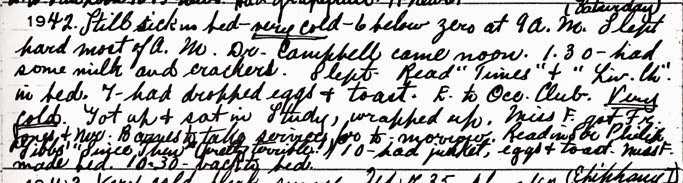
 Saturday, Jan. 10, 1942: Still sick in bed - very cold - 6 below zero at 9 a.m. Slept hard most of a.m. Dr. Campbell came noon. 1:30 - had some milk and crackers. Slept. Read "Times" & "Liv. Ch." in bed. 7 - had dropped eggs & toast. E. to Occ. Club. Very cold. Got up & sat in Study, wrapped up. Miss F. got Fr. Jones & Mr. Barnes to take services for tomorrow. Read in Sir Philip Gibbs' "Since Then." (pretty terrible.) 10 - had junket, eggs & toast. Miss F. made bed. 10:30 - back to bed.

January 11, 1942
  Sunday, Jan. 11, 1942: (Epiphany I) Very cold, snowed at times, very bleak, gray, below zero. Feeling better. Stayed in bed till 3:45. Had some breakfast -- 11. Fr. Jones of St. Edmund's took Stockbridge service. Read "Times" in bed, Miss F. sick with same malady, Nellie French in to see her. Up 3:45, shaved, shower bath - dressed -downstairs - first time since Thurs. night. 5:45 - Wm. L. Shirer. 6 - news. Helped Miss F. make my bed. E. took 3/4 hour at Air Raid Station. Wrote letter of congratulation to Bp. (5th Cons. ann. - Tues.) Miss F. to bed 8 - sick. E. studied first aid book in kitchen. I sat in study & read in Girard's "Face to Face WithKaiserism." 9 - Ford Hour (pianist). 10 - had junket, milk & crackers. Not feeling too well. Cold is very excessive. 10:30 - to bed.