Showing posts with label 82nd Airborne. Show all posts

Monday, September 30, 2013

Mother Knows Best: A story from The Hospitality Room

Walter "Red" Rose

     The hospitality room at a reunion of my father's tank battalion from World War II  turned me into an oral historian. I entered in the middle of a story Wayne Hissong was telling about the hardest thing he had to do in the whole war: after returning home to the small town of Argos, Indiana, he had to face the mother of a buddy who entered the service with him and was killed. Wayne may not have known it but he struck upon one of the great issues of World War II or any other war: dealing with emotions. Was facing his friend's mother more difficult than driving an ammunition truck for 11 months in combat, or being ambushed, wounded and captured near the end of the war by starving German soldiers looking for food and cigarettes? I never asked him. Years later, though, I would learn that his buddy, a tank driver, was decapitated by an armor piercing shell on the battalion's first day in combat. How do you face a friend's mother knowing you know what happened but there's no way in hell you're going to tell her those details?
During the 1990s, as I sat around those circular tables in the hospitality room often with two or three of the veterans and some of their wives, companions or friends, munching on Chex Mix and premium peanut free mixed nuts from Sam's club or homemade zucchini bread from one of the veterans' wives, sipping on soda or beer or nursing something stronger, I would plunk my little Sony Recording Walkman or Radio Shack knockoff in the middle of the table. The result was a unique bit of history, casual conversations that ranged from who was in the hospital and who had a new grandchild to intense accounts of combat in the European Theater of Operations.
In junior high school – what would now be called middle school – my class took typing. I got pretty good at it, and as the cassettes piled up I tried my best to transcribe them. Those thousands of pages of transcripts have provided material for my books and blogs, but much of it has never escaped the confines of my hard drive.
The 712th had some great storytellers – Wayne, Ed Stuever, Jim Flowers, Forrest Dixon, Dan Diel, Joe Fetsch, Clifford Merrill, Walter Galbraith, Dale Albee, Ellsworth Howard, not to mention some of the wives, like Helen Grottola, Evelyn Knapp, Jeannie Roland – and when they entered the hospitality room it seemed as if the men checked their post traumatic stress at the door and relived the war in the company of those who lived it with them.
These are some of the stories from The Hospitality Room.

Mother Knows Best

When the battalion veterans began retiring and either spending the winter in Florida or moving there permanently, the idea of having a casual get-together, in addition to the regular reunion, was tossed around. Sam Adair, a veteran of the Headquarters Company assault gun platoon, organized the first one in the 1980s. Then Jack Roland, also of Headquarters Company, moved to Bradenton after his health forced him to retire from the photography studio he ran in upstate New York. He was elected mayor of Bradenton, and was able to secure a good deal for the battalion at a Days Inn on Route 41. The battalion could supply their own hospitality room, and could take over the kitchen for the Saturday dinner so that Major Clegg "Doc" Caffery, who owned a plantation and a shrimp boat in Louisiana, could cook up a batch of crawfish etouffe.
The 1993 mini-reunion, late in January, was the first mini-reunion I attended. This is one of the many stories I recorded, as Walter “Red” Rose of Ahoskie, North Carolina, a corporal in Headquarters Company; Doc Caffery -- who was not a doctor but had been the battalion G3, or operations officer -- and I sat at one of those circular tables.
"It was right at the very beginning of the war [the battalion's first day of combat was July 3, 1944]," Rose said. "Not all the outfits had been committed, but we sent some tanks out to support the 82nd [Airborne Division]. We lost a couple of tanks. And Dickie [Forrest Dixon] was attached to Service Company.
"He came in one evening and he says, 'Captain Laing, we've lost two tanks. We've lost contact with them, and if they're knocked out, I've got to requisition two more from ordnance in the morning.'
"This is only the beginning. You're learning. He said, 'I've got to get to 'em and see that they're knocked out.'
"Laing said, 'Get the jeep, Rose.'
"I said, 'Captain Laing, this is not our duty. We're going someplace we don't have no business.'
"It was in the evening, and we were going down this old dirt road. I could see the terrain begin to rise. I remember this just like it was yesterday. We come to an area, and there wasn't nobody, no vehicles, no nothing. Everything just as quiet as it is right here. We come to a little crossroad, and there laid some infantry, down in a ditch, with their guns stuck across.
"Dixon starts to say something to them.
"'Get the hell out of here, you sonofabitch!' one of them says. 'You're gonna draw fire. Get that damn jeep out of here!' And they began to holler all the way down that line.
"Dixon said, 'Straight on.' I just went straight on, got about a hundred and fifty feet, and by god looked out, and if you've ever seen rain on a mill pond, that's what it reminded me of. Before I could get out of my jeep, those mortars were falling, bup-bup-bup-bup, and I hit the ditch. The jeep had no emergency brake, and I was out of that thing, it was still going. I hit the ditch and I lay there, and I could feel the shrapnel. Now there was some infantry on ahead of us, because the line, the wires, were laying in the ditch, and I could feel them  jerk when the shrapnel was coming down the banks.
"Finally it lifted. And when it did, Laing said, 'Get the jeep, Rose'”
"I got in that jeep and I put it in gear and we took off. And them infantry was just a cussin' us.
"We got back and I said, 'Captain Laing, I'll take you anywhere you want to go. But where there's no business of mine, I'm gonna let you do the driving from now on.'
"My mother told me, 'Son, if you go looking for trouble, you'll always find trouble.'
"We came on back, and that night we're setting there, we couldn't have lights. 'Well,' Dickie says to Laing, 'I've got to go. I don't know whether I'll ever make it back or not, but I've got to find them tanks.' Now, you remember he had an old trenchcoat?
"Yes," Caffery said. I remember he had an old trenchcoat. He wore it all the time."
"The next morning," Rose said, "now he told this, and I don't think Dixon would lie, he said, 'I got in the ditch, crawling to them tanks,' and he said the Germans seen him, and he said that he had bullet holes across that trenchcoat, by god, I know I've seen it, and he told Captain Laing and us  – now this was in the very beginning of the war, so I can remember a lot of this – he said, 'I was crawling up this ditch, and I looked ahead and there lay a German ahead of me.' And he said, 'I stopped. I guess I laid about thirty minutes. He never moved and I didn't either.' He said, 'I pulled my pistol out and started crawling. Well, I had to go over the top of him. The ditch was shallow. if I stood up I'd get shot.' He said, 'I crawled on up and laid my hand on the top of his head, and it was cold, and I went right over the top, and I went on.'”

(Walter "Red" Rose passed away in 2009 at the age of 86)


Kindle edition only 99 cents


Wednesday, May 15, 2013

An Oral History Audiobook Sampler

 
   Today I'm going to don my chapeau as an oral historian, and post a the audio from a sampler CD containing tracks from several of my oral history audiobooks. The audiobooks are available in my eBay store. You can also order audiobooks by calling the oral history hotline at (888) 711-TANK (8265).
   Click on the links below to listen to the sampler in mp3 form.
 
Track 1 Introduction (Aaron Elson)
 
Track 2 Karnig Thomasian, POW of the Japanese, from "For You the War Is Over"
 
Track 3 Sam Cropanese, 712th Tank Battalion, from "The Tanker Tapes"
 
Track 4  Ed Boccafogli, 82nd Airborne Division, from "The D-Day Tapes"
 
Track 5 Vern Schmidt, 90th Infantry Division, from "Kill or Be Killed"
 
Track 6 Bob Rossi, 712th Tank Battalion, from "Once Upon a Tank in the Bulge"
 
Track 7 Bob Cash, 492nd Bomb Group, ex-POW, from "March Madness"
 
Track 8 Russell Loop, 712th Tank Battalion, from "More Tanker Tapes"
 
 
Track 10 George Collar, 445th Bomb Group, from "The Kassel Cassettes"
 
Track 11 Jerome Auman, from "Four Marines"
 
(c) copyright 2013 Aaron Elson


Thursday, July 5, 2012

'Who Needs It More, Him or Me?"


The Landsberg concentration camp memorial

Here is the story from my new book, "Conversations With Veterans of D-day," to which I referred in my previous post. Len Goodgal is a 101st Airborne Division veteran of the 506th Parachute Infantry Regiment, whose I Company often fought near or alongside the fabled Easy Company of "Band of Brothers" fame. There but for a couple of letters you might have seen this story on HBO or read it in a bestseller.

I've included a little more of the interview. As I mentioned in the previous post, on D-Day Len landed in the water near the base of Pointe du Hoc and scaled the cliffs with the Rangers. This story occurs much later in the war.
  
Aaron Elson: You mentioned Landsberg Prison.

Len Goodgal: Yes, they liberated Landsberg Prison. I didn’t see the prison. I saw the prisoners. I’ve got an interesting story about that, because when we liberated Landsberg I was right outside the town. We were in a machine gun position with Eddie Austin, and we had three of these refugees with the stripes, you know what they looked like. They were Russian I think. I don’t know whether they were Jews or not, but they looked horrible. I mean, they looked nightmarish. And us guys, we were trying to feed them something. We had D-ration bars we were putting into our canteens and heating them with water, and we had some pickled eggs we used to find in the basement, and some bread that we grabbed from someplace, and a couple of things, I don’t know what the hell we had there, we’d find stuff in cellars.
These guys wanted something to eat, which we were trying to feed them, some of the cocoa. And this guy was shaking. Eddie Austin took his coat off and gave it to one of these guys. And Jesus, I almost flipped. I said, “Are you out of your mind? What are you doing? Giving away your overcoat?”
He said, “I can’t not give it to him.”
I said, “What do you mean you can’t? They’ll bust your balls for that.”
He said, “Who needs it more, him or me?” He or I. Him or me. “Who needs it more, he or I?” is correct. He said, “Who needs it more, him or me?” Eddie Austin was a superintendent of schools in California later on, but that’s besides the point. He knew what he was saying, “Who needs it more, him or me?”
“I don’t know, Eddie,” I said. “They’re gonna bust your balls.” Until my dying day I’ll never forgive myself for not giving the other guy my coat, but they weren’t shivering. This guy was really shivering. I didn’t feel bad. I said, “I think you’re out of your mind.” I said, “Eddie, what’s it gonna do for him? Put him in a house someplace and build a fire.” We had a fire going there. We fed them. They couldn’t eat the stuff, it was too rich for them. The Red Cross got ahold of these guys and took care of them. In fact, the Red Cross MPs came in to most of these camps. At Dachau they got in right away. They didn’t let us in. We went right past Dachau. I didn’t see them. I mean, they didn’t let them out of there. You would see guys roaming around if they did. We picked up a guy going through Germany, and he went all the way to Berchtesgaden with us, and the cook took care of him. Maurice. I don’t know what his last name is. He spoke about five languages. He’d been in a concentration camp for years. He was a skinny guy like that. And he had a horse and wagon, and anything he could steal he put in there. He and the cook were, I don’t know if they were chopping people’s rings, I don’t know what the hell they were doing, but they were getting enough loot to live for the rest of their lives. I mean, Maurice was helping him. And the cook used to carry a .45 pistol on him, I remember, all the time. And he was a pretty good guy, just gung-ho. Till he became the cook. How he got to be our cook, we had a guy named Feoli who was a cook and he shot his dick off in Holland because he fired his pistol while he was cleaning it. Feoli. He lives in New York State someplace. His .45 went off and it shot his dick off. I remember that, and oh, we laughed about that. Well, you know. What is it, pathos or something, I don’t know what the hell you call it. It’s funny as hell but when you think about it, in other words it’s not funny. Oh, it was brutal. We’d look at each other and laugh. “Don’t give me no pistol.” We used to pick up pistols, P-38s and Lugers and all different kind of weapons, Schmeissers and stuff. Most of them disappeared or we traded them along the way.
Some of the guys came back with them. Most of the guys didn’t even come back with a pistol, on account they were afraid they’d use them. Some of them just didn’t want to have them around. Weapons didn’t mean anything anymore. Glad it was over. But I remember us being in Solfelden, and they had horses there and we were horseback riding, German horses, and we used to go horseback riding in the afternoon or in the morning. They had guys that knew about horses taking care of them. To me it was a novelty. It was recreation. I was there from May, the war was over May 8th, I was there from May till September, and hey, it was a walk in the sun being a soldier. Just imagine how we felt over there. Anything you wanted to do. If you wanted to fraternize, and you weren’t supposed to fraternize with the Germans – everybody had a girlfriend someplace. Everybody. I can tell you an interesting story. I read Solzhenitsyn’s Gulag, I don’t know if you’ve read it. You’ve got to read it. It’s brutal reading. You’ve got to read that book. And in it he talks about them returning slave laborers, women, back to Russia, and the Russians  sent them to Siberia. When I was in Berchtesgaden, we used to use them, they were working as cooks and stuff for us because, hey, the Germans don’t want them anymore, they got captured, were working in the fields at home, in the hotels, hey, so the government took care of them. Then one day they came along, they took them all, put them on trains and sent them back to Russia. Solzhenitsyn talked about them, taking those people and putting them in Siberia. And I didn’t know. I thought they were going home. And they didn’t really want to go home, a lot of them, because, hey, when you see Russia, what it was about, and you see what Germany was like in Bavaria, even with the work that went on. Hey, it was a better life in a lot of ways, and some of them lived with German guys.
We had thousands of troops surrender to us coming off the Russian front. They wanted us to turn around and fight the Russians. They came in with all their equipment, ready to fight. They would turn around and they were gonna fight with us. They put them in camps. We did not abuse them. They talk about starving them to death. Eisenhower did not do that. Whoever wrote that stuff is a brutal liar. We did not brutalize the Germans, although there was high unemployment among them, there was not work and all that. We did not starve them or brutalize them. We weren’t allowed to do that.

Aaron Elson: Back to Landsberg, was that a concentration camp?

Len Goodgal: Yes, it was a concentration camp there and a prison. Landsberg Prison is where Hitler got his start, I think, one of those places. They had the putsches there. Beautiful area. Berchtesgaden, and that area through there, is probably one of the most beautiful parts of the world. You have to go to see it to see, July and August, where’s it’s warm and sunny and the fields are growing, there’s snow on top of the mountains and it would melt and we’d come the next day and clouds would go over, there’d be snow on the mountains. A gorgeous, gorgeous countryside. And they kept it nice, too. The Germans are meticulous. Clean. You can’t believe that these people were Nazis, and how brutal they were. Committed all these brutal acts. When you know the people. Germany was a country of kinder, kirche, kuchen. Children, church and cooking, that’s what a woman’s job was. Children he made, women and children for the Reich, screw the church, and fuck the soldiers, you know. Hooray for Germany. Blond and blue-eyed, Hitler was a brown-eyed, black-haired sonofabitch, who the hell is he kidding? Blond hair and blue eyes? I mean, let’s face it, did he have blond hair? Did he have blue eyes? He had brown eyes and black hair. It was ridiculous. It was so ridiculous that you wonder how they put over what they did. And they put it over. They did it. They captivated the state, captured the times. They were in a Great Depression, saw no way out, were looking to blame somebody and anybody they could put their hands on, it was their fault. Never my fault whatever happens to me, it’s your fault. You’re to blame. Not me. If I want to believe it, I can believe it. People can always believe anything. That’s what happened in Germany. The Depression. They lost contact with the reality of what kind of people they were. They thought of themselves as Saxons, not Anglos. Their image was the Prussian. And that was sad because they’re not that way, they were churchgoing people. Martin Luther came out of Germany.

- - - 

The new book, "Conversations With Veterans of D-Day," is not yet available in print -- I still have to iron out some glitches in the header/footer/page numbering/table of contents departments, but it is available in Amazon's Kindle store. Don't have a Kindle? You can get a free Kindle app for your computer or smartphone.

Amazon's free Kindle app


Sunday, October 17, 2010

A tale of two uncles


The Saar River at Dillingen, December 1944. Photo by
Robert Pitts, 150th Engineer Combat Battalion.
On Oct. 6th I received an e-mail from Patricia Robison, asking if, in my interviews with veterans of the 712th Tank Battalion, I came across any information about her uncle, Lee Miller, who she said was killed on Feb. 27, 1945. The name rang a bell -- well, I mean it really rang a bell, like ding-ding-ding-ding-ding -- but I was uncertain just where in the dozens of interviews I've done with veterans of the 712th, the unit with which my late father served, I'd heard his name.

I knew he was in B Company, so I forwarded the e-mail to Lou Gruntz Jr., the B Company historian. The reason I remembered Miller's name was because his company commander, Jim Cary, once told me he put Miller in for a silver star -- which he was awarded -- for volunteering to disable a tank that had to be abandoned when the battalion retreated across the Saar River in December of 1944.

The battalion didn't really "retreat" across the river, the way the Germans retreated from Stalingrad or Napoleon from Moscow. Rather, it was a strategic withdrawal, effected after the 712th and its attached 90th Infantry Division (I know, I know, it was the other way around) fought for and captured the city of Dillingen, where my father was wounded for the second time. Dillingen was about 100 miles south of Luxembourg, where the Battle of the Bulge had begun. The 3rd Army was needed to break the siege of Bastogne, although according to one account I heard, there was some concern that the German juggernaut might turn south and overrun the 90th Division.

At any rate, the division pulled back across the Saar and the 712th tanks went across first on a pontoon bridge, and when that was destroyed by German artillery, on a ferry. Two tanks, one in C Company and one in B Company, were inoperable and had to be left behind.

Lee Miller stayed to destroy the B Company tank, most likely by pouring a five-gallon can of gasoline into the hatch and then dropping in a hand grenade. He was given a set of coordinates and was to meet two infantrymen, who would escort him across the river in a boat.

When he arrived at the meeting point, there were no infantrymen and no boat. So he swam across the Saar River, in the middle of an exceptionally cold December.

Cary was wounded during the Battle of the Bulge and never did learn of Miller's fate until he spoke with some B Company veterans at the 1993 mini-reunion of the 712th in Bradenton, Florida.

It was there that I interviewed Juel Winfrey, a B Company veteran, who spoke about Miller. A search of the B Company interviews in my files turned up this passage:

Juel Winfrey: "I recall an incident, and here again, this was further in -- well, it was after -- the next real thing I remember was Dillingen, Germany, where we had to cross the Saar River. We crossed on pontoon bridges. And I was on a tank at that time with a young fellow as a tank commander named Lee Miller. Lee was another boy from Oklahoma, where I'm from. However, I didn't know him before. But the Sixth Cavalry had made arrangements with the 712th Tank Battalion to get one company -- not one company but one platoon -- of tanks in an area to support them. And they sent this lieutenant back to pick us up.

"Well, this lieutenant came back and he led us by jeep, with the tanks following, to an area that was supposed to be secured. And when we got up there, our platoon leader, Lieutenant Gaggett, he said, 'Now you guys, one tank of you get your mess kits and your rations and go in this house back here, and make an evening meal.' He said, 'Now the other two tanks, you keep a loader and a gunner in the tank just as an outpost, and the other three of you go.' Well, we climbed out of our tank, got out in front of it, and we had a German ammunition..."

Here, the 45-minute side of the tape ran out, and some of what Winfrey said was lost before I could flip the cassette. So I'll interject a little supposition. The trip on the pontoon bridge was the aforementioned withdrawal, and the incident where the platoon was supporting the 6th Cavalry is the one where Miller was killed some two months later, when the battalion would have been in the Siegfried Line.

Once again, Juel Winfrey: "Five of us got out, and you know how wide the front of a tank is, we were lined up, me right in the middle, and Lee Miller on my right side, and I can't remember who the assistant driver was, but he was on the other side. Aaron Craig, who was the loader, was over here on my left side, and then the other member of the crew was over here. And all at once, we heard the German shell come. And Lee Miller said 'Look out!' And that's the last words the man ever spoke. The shell caught him right, the shrapnel, caught him right in the back, and it killed him like that. Standing right here at my shoulder. Aaron Craig over on this side, he was badly wounded, and they had to get the medics to take him back to the hospital. And the other three of us didn't get scratched once. Now that's one of those close calls that make you think the Good Lord's with you, too.

"But this Lee Miller had been with, I was also in a tank crew with him when we went across the Saar River. And when we crossed the Saar we went into Dillingen. The town had been completely vacated, there wasn't a handful of civilians left. And we sat there for a few days waiting for the infantry to cross and catch up with us. Which they never did. Or at that time at least. Because that's when they started the Bulge. And they gave us orders to pull out.

"And we had one tank that had been mired down in the mud, and they wanted a volunteer to stay behind and blow up that tank after the rest of us got back across the river. We were going back across that pontoon bridge. Well, he was to meet a couple of infantry guys and the three of them would come back together, because the infantry guys had a bunch of ammunition they had to blow up.

"And when Lee got back to this designated place that he was supposed to meet the two infantry men, they never did show up. This is in December.

"He stayed and blew up the tank, and came back to the place to meet these two guys and they weren't there. He swam that Saar River, that December night, cold as the dickens, and I don't remember the exact date, but it must have been a week or ten days before he was able to find our unit, to catch up with us. And after all of that, he was the one that was killed later in this situation that I just described."

I'll admit it. I patted myself on the back and said to myself, "Damn you're good!" But the truth is I get many requests like Patricia's and am only able to provide such valuable information for a few of them. I haven't heard yet from Lou Gruntz Jr. but with his extensive knowledge of B Company's history -- he traveled to Europe with his father and they retraced the company's battle route, and Lou chronicled the company's history in an excellent, yet unpublished, book -- I imagine he could send Patricia even more information about her uncle.

'The Flower That Never Blossomed'

One other recent incident, however, also deserves a proverbial pat on the back. I was formatting my book "A Mile in Their Shoes" for the Amazon Kindle e-book reader -- when I say formatting, I mean retyping, because the original document was lost with the demise of a computer several years ago. And it's a good thing I retyped it, because I discovered about two dozen misspellings of names and places that were easy to verify on the Internet today; not so easy in 1996. But I digress.

One of the dozen veterans whose edited interview transcript I used in "A Mile" was Ed Boccafogli, a paratrooper with the 82nd Airborne Division who jumped into Normandy. Ed's was one of the first interviews I posted on my World War 2 Oral History web site @ tankbooks.com, and it has served as source material in a couple of books, properly credited, that I know of, and some or all of it has been re-posted on a couple of other sites.


John Daum
I thought it would be a good touch for the Kindle edition to add the date of Ed's death, so I went to the Internet in search of an obituary. I didn't find one, but I did find the date that he died, and added it to the book.

I also found, at a web site for the 508th Parachute Infantry Regiment, an account written by Thomas Stumpner of Fox Lake, Wisconsin, who is the nephew of Johnny Daum, about whom Ed told a story. The story, about a premonition Daum had that he would be killed on D-Day, was picked up and used by the author John McManus in a book called “The Americans at D-Day.”


“For as long as I can remember," Stumpner wrote in April of 2008 in a story he posted on the 508th PIR web site, "my mother always had two pictures of my Uncle 'Bud' hanging on the wall. The first was a group picture of Company D, 71st Battalion, at Camp Robinson, Arkansas. The other was an 8-by-10 of him in his paratrooper uniform.

“As a child I would occasionally ask questions about him. She would usually just answer that he died in the war. That he stayed back to guard the camp and was killed by a sniper. The Army even reported that he was killed 6/23/44 when the actual date is listed as 6/8/44. After I moved from home I would think of Bud but never really followed through with more questions. When I was very young, I told her that I would go to Europe and find out about him. At the time I don’t know if she (or for that matter, even myself) believed that I would follow through with my actions.

“In 1994, the 50th anniversary, my interest piqued again about my Uncle Bud. I remember seeing stories about the invasion on the 'Today' show with the veterans at Normandy. It was at that time I realized what battle my uncle was in and that he may have been killed on D-Day. I remember a fishing trip at the time with my brother Chuck, who served in Vietnam. We talked about the jump and what Bud may have gone through. Little did I know of the things he went through that night. My sister Virginia had a friend that had visited the Normandy American Cemetery at this time. She took a picture of his cross and brought back booklets of the cemetery.

“Then, when the show 'Band of Brothers' came out in 2001, it really started to make me think about Bud. I really wanted to find out about him. I started thinking, 'How do I start? Who and how do I contact somebody?' What compounded the problem is that I did not know my Uncle’s name. All I ever knew him by was Bud. I always assumed, wrongly, that he was named after his father, Paul. It was not until my mother took ill in 2006 that I found out my uncle’s name was John A. Daum.

“I did a search for him on the computer and found out that he was with the 508th PIR of the 82nd Airborne. I have found out a lot about him through the help of Dick O’Donnell and his web site, www.508pir.org. With this information I have decided to tell everyone about my Uncle Bud.

“John Daum was born on April 24, 1924, to Paul and Frances Daum in Marathon County, Wisconsin. He was the third child of four. He had three sisters, Helen, Marcella and Rosella. He received his education at St. John’s Parochial School. He later worked for a farmer near Nasonville, Wis. From October 1942 to April 1943 he worked at the Weinbrenner Shoe Factory in Marshfield, Wis.

“In April 1943, he entered the military service. He served basic training at Camp Robinson, Ark. From there he was to go to Fort Sheridan, Texas, but instead he joined the paratroopers.

“In August he went to Fort Benning where he started his paratrooper training. At this time he was with Company H of the 541st. During the next two months he trained to become a paratrooper. He stated how they trained, that they would run everyplace and did a lot of exercises all day. He claims to have had fun doing five- and ten-mile runs, which does not sound like fun to me. He learned how to pack his chute, jump from towers and finally from a plane. In a letter that he wrote to my mother, Helen, he told her to tell my father that 'a lot of fellows were getting sick' but he didn’t and he didn’t even have to 'clean his shorts.' He also wrote to his father after one of the runs. He said that it was 'really hot and a lot of soldiers were getting sick,' but he didn’t and he kept going. 'That Daum blood kept me going,' he wrote. It paid to have a sense of humor going through training.

“On Oct. 2, 1943, he received his wings. From there he went to Camp Mackall and joined the 508th. He wrote his mother and said 'the 508th is a good company to be in and they will be going overseas in three or four months. I am proud to be in the 508th.' Sometime at the end of October he came home for the last time. In returning to camp, he recalled of him and a fellow trooper from Illinois having trouble making the train because of a flat tire on the bus, but they both made it okay.

“At the end of 1943 John and the rest of the 508th went to Northern Ireland and then to Nottingham, England. It was there that Sergeant Walter Barrett had told me of his contact with John. 'I knew him personally. I was closely associated with him while we were stationed in Nottingham. We trained at this location preparing for the D-Day invasion of France. John was a good-looking airborne soldier – with a full head of blond hair. He could have easily impersonated a German soldier. One thing I remember about our brief association was that John and I, along with the guidance of an old regular Army sergeant named John Petric, would practice ‘The Manual of Arms’ (precise movements in handling of a weapon during a drill or ceremony). We became pretty good at it. I was proud to have entered combat with John.'

“In his letters home from England John said there was not much to do in England but to train and to go into town. He compared Nottingham to Marshfield and mentioned the English girls as being nice. In his last letter home on May 10th he mentioned the training and receiving a package from home. He enjoyed the candy and was wondering if in the next package his mother could send some socks. He also told everyone not to worry and that he hoped to be home in a year. In almost all the letters he sent home he would sign them 'Good luck and love, Bud.' In hindsight, it was they who should have wished him good luck.

“On June 6th the invasion of France was on. In the book 'The Americans at D-Day' by John McManus there was a story by Ed Boccafogli of my uncle the day before. The story goes as follows: 'Some could not escape the terrifying, depressing feeling that they were witnessing their last sunset. Not far away from where Sergeant Brewer sat writing to his father, Private Ed Boccafogli, the B Company trooper who was so disappointed at the previous day’s postponement, noticed one of his buddies, Private Johnny Daum, standing outside the tent, ‘like a statue looking into space.’ The skinny, towheaded Daum barely looked a day over sixteen. Boccafogli had never known him to act so morose. He was a few years older than Daum and thought of him as a little brother. He walked over to him. ‘Hey, Johnny, what’s the matter?’

“ 'Daum hardly even replied. He just stood there in a kind of stupor. Boccafogli was really concerned now. ‘What the hell’s the matter with you?’

“ 'Daum finally replied in a matter-of-fact tone, ‘I’m gonna die tomorrow.’

“Boccafogli tried to cheer him up: ‘Ahh, come on. Some of us will, some of us won’t, but you ain’t gonna be one.’

“ 'Daum could not be dissuaded. He insisted on the imminence of his death. Eerily enough, he was right. He got killed on D-Day. Boccafogli never forgot him. ‘These things stay with you the rest of your life.’ ”

“Today John is laid to rest at the Normandy American Cemetery and Memorial in Colleville-sur-Mer, France. His grave is Plot F, Row 23, Grave 42.

“In a conversation that my niece, Gayle, had with my mother she explained why Bud was never returned to the States. “My mother did not bring him home because a neighbor had brought her son home for burial and it was like losing him all over again and she did not want to go through that again. Plus Bud was resting where they had buried him.”

“So that is the story of my Uncle Bud at this time. What I have learned was that my uncle was not a very big man, probably about 5-4 and maybe 140 pounds. My mother once told my niece that my uncle “was not very big, was quiet, and enjoyed to smile and laugh.” In the past my mother always told me that her mother said that “Bud was the flower that never blossomed.” I think today she would not find this to be true at all. As Walter Barrett had e-mailed me, “I am proud to have known him – John A. Daum – a great American and a brave trooper.”

“About the only thing left to say is: 'Good luck and love.' ”

Monday, May 31, 2010

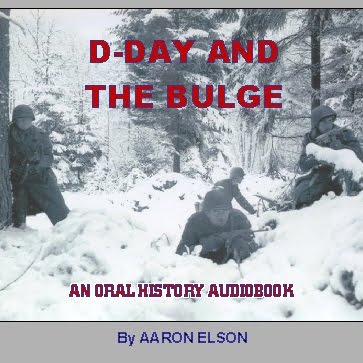
D-Day and the Bulge


Pete De Vries doesn't tell war stories. The stories that are told should be about the young men who didn't get to come home, he said when I interviewed him in 1997. Well, De Vries, who served with the 82nd Airborne Division, the Rangers, and the 10th Special Forces in World War II, Korea and Vietnam, and retired as a sergeant major, did tell one war story, somewhat reluctantly. And he told it not to bring any glory upon himself; in fact, he steadfastly declines to identify the hero of the story, and the only reason he told it in the first place was to illustrate a point.

He told the story in a letter to the editor of the "Static Line," a monthly newspaper for and about paratroopers. The letter was in response to an article by a Marine about the pride that the Marine had in his unit.

A lone GI with a bazooka was guarding a road during the Battle of the Bulge, Pete's story went, when several American soldiers, led by a lieutenant, emerged from the forest and asked the way to the American lines. The GI showed them the way, and the lieutenant said he'd better accompany them because they were being pursued by two German tanks.

At which point, the lone GI said, "You don't have a thing to worry about, Sir. I'm in the 82nd Airborne and this is as far as the bastards go."

A few years later, Pete was attending a dinner when he noticed a sketch on the wall of a paratrooper in full gear. Underneath him was the caption "I'm the 82nd Airborne and this is as far as the bastards go." A short while later, he said when telling me about this, he heard that someone at another table was claiming to have been the GI who originally made the statement. So he went over to the table and asked the veteran if he remembered who the lieutenant was who was looking for the American lines.

"How should he remember that?" I asked.

"I'll give you a hint," Pete said. "He had a famous father and was a senator."

I still had no idea, so Pete told me it was Will Rogers Jr. Actually, Rogers was a Congressman who resigned his seat to enlist.

I didn't do much homework in high school, but since I've become an oral historian I've become far more diligent. So the next day I called the Will Rogers Museum and the curator sent me copies of a few pages from "Gare la Bete," by Calvin Boykin, a book about the 7th Armored Division. The pages included an account of a reconnaissance platoon led by Rogers on Dec. 23, 1944, in the vicinity of St. Vith, being shot up before reaching the safety of the American lines.

Pete still declines to take credit for being that lone sentry, and at least one other veteran of the 82nd Airborne that I found on the Internet is given credit for the saying. Nevertheless, one of the citations Pete allowed me to read into the tape credits him with singlehandedly destroying one German tank and disabling another.

Pete's and several other interviews are included in "D-Day and the Bulge," an 11-hour collection of interviews that make up my newest audiobook.


Other veterans in the set include Len Lebenson, a sergeant in the headquarters of the 82nd Airborne Division who went into Normandy in a glider that crashed into a shed; Maurice Tydor, a radio operator in division artillery of the 101st Airborne Division; Samuel Feiler, a dentist in the 101st; and a group interview with five veterans who talked about the siege of Bastogne; and Valentine Miele of the 1st Infantry Division. Also included is my 1994 interview with Leonard Lomell, the Ranger credited during the Normandy invasion with destroying five large German coastal guns that were supposed to be on Pointe du Hoc but were actually inland.