|
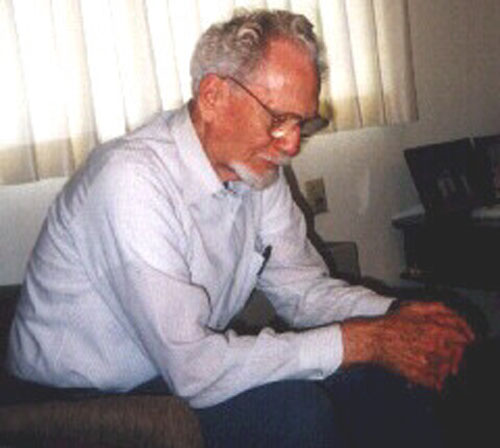
| Bob Anderson |
Aaron Elson: Was
that the very first day?
Bob Anderson: Well,
I won’t say the first day, but it was close to the first day. I’d say the first
week. The first day, and I don’t know if they ever mentioned it, we hadn’t been
in, I’ll say action, I’ll say an hour, when Lieutenant Tarr out of the second
platoon and another boy out of Headquarters Company by the name of Phil
Schromm, they were the first two men in our outfit who got killed.
Aaron Elson: I’ve
heard several stories about how Tarr was killed. See, my father was supposed to
replace Tarr.
Bob Anderson: Oh, he
came in right early.
Aaron Elson: He
reported to Braatz, and Braatz said he was showing him the tank, and he told my
father to be careful getting off, and my father jumped off and sprained his
foot and went to the medics, and then the tanks went into action without him.
Bob Anderson: See,
George Tarr, he was Braatz’s platoon leader, and I can’t help but believe that
every time, see, then your sergeant would move up to the Number One. Every time
Braatz would get a replacement, just within a week or maybe not that long,
something would happen that this lieutenant would get hurt or wounded, so
Braatz would have to take over. Finally they offered Braatz a lieutenant rating
and he was commissioned in the field.
We had a, well, I call them
90-day wonders, maybe I shouldn’t, these were men that came out of the States,
and came over and tried to tell us boys how we should fight and this and that.
I had a Lieutenant Bell...
Aaron Elson: I was
talking to John McDaniel at the reunion and he was talking about Lieutenant
Bell. He said he was an oddball.
Bob Anderson: That’s
what I say. I had, here’s a picture of a man right here, he was my assistant
driver after he came in and replaced a driver. I don’t know what rank he had in
the infantry but he had to do something else. His name was John C. Owens. And
he came in and he was trying to tell us how to drive a tank and how to do this
and that. He was my assistant driver. It ended up that one day – well, I’ll get
to that later on. Then I lost another buddy of mine, this Percy Bowers. He was
killed at Avranches.
He was killed in a cemetery. His
tank was knocked out. Pretty near all of us was out of ammunition. His tank was
knocked out, he got out of his tank and was carrying a white flag, crawling
back, and some German shot him, with a white flag, crawling back. That’s where
he was killed.
Aaron Elson: Other
people in Percy Bowers’ tank were killed also, weren’t they?
Bob Anderson: Well,
there were. See, Percy Bowers was in the first platoon. I can’t tell you.
Aaron Elson: And
Bell was your platoon leader?
Bob Anderson: Well,
first I had Lieutenant [Ed] Forrest.
Aaron Elson: What
was he like?
Bob Anderson: He was
a very good man. He was just a common, ordinary man. He was with us all the
way. I liked him. All the officers we had when we went over, you didn’t have to
go around and salute them, even the big shot, [Col. Vladimir] Kedrovsky, after
he took over from Randolph [Col. George B. Randolph was killed during the
Battle of the Bulge], Colonel Kedrovsky was just an ordinary man. He knew me
when we came along, and it was Big Andy this and Big Andy that. When we had our
first reunion in Rockford he was there, and him and I sat and talked a long
time.
Aaron Elson: Was
Krysko in your tank, Steve Krysko?
Bob Anderson: He was
in our outfit. Now, here’s where I got my first Bronze Star, in Dillingen. I
was the first tank across. The engineers had laid down our bridge, and we were
sitting on the bank waiting to go across, and they came back and they said, “Now,
when you go across, go slow.” Well, you know how it is with a 32-ton tank going
across water. As I was going across, I was probably three-quarters of the way
across or so, two German planes came in and started strafing across the river.
And you ought to have seen me go across the river. I didn’t go slow. Anyway,
the two tanks behind me got mired down. Our third platoon, we got all five
tanks across, but two of them got mired down out in the mud. I took my tank,
and we had cables, oh, I might say 15, 20 feet long. I hooked three of them
together and dragged them back, and hooked onto the tank back there in the
mire, and then I went and got back in my tank, and I got the two tanks pulled
back out.
Aaron Elson: Who
hooked up the cables?
Bob Anderson: I did.
Some of the others didn’t know how to hook up a cable. I hooked the cables
together and got these two tanks out that were mired in the mud, and that’s how
I got my first Bronze Star. Of course, I pulled my tank, we got in there right
up in front of a store and we looted that.
Now this is the picture that they
took of me cutting this meat up. They sent a great big one which I’ve got in a
frame, they sent that back to my wife. And then Lieutenant [Ray] Griffin, I don’t
know how he got hold of that, but he sent that to me. This John C. Owens, he
was my assistant driver. It says that I killed a cow with a broken leg, well,
it didn’t have no more of a broken leg than you and I when I shot that cow.
This Owens, later, we had orders one night to move out, and I’m trying to think
who our company commander was. I know Hagerty was my tank commander.
Aaron Elson: Could
it have been George Coulton?
Bob Anderson: No,
Coulton was a driver. You’re thinking of George Cozzens. Him and I tangled two,
three times. He could have been. But anyway they told me – see, I wasn’t going
to move out that night. Anyway, this Cozzens told us that we had to move out to
a certain place that night, and I said, “No, I’m not going to go. I’m not
taking these tanks, my tank, out after dark.” And him and I went round and
round and he assured me that there was nothing down this road in front of them
pillboxes, that they were all clear. And I can’t think who else was in on it. I
know Hagerty was there. He was the platoon leader. No he wasn’t the platoon
leader. Because I was still driving the third platoon tank.
Aaron Elson: Do you
remember where this was?
Bob Anderson:
Oberwampach, that’s where this happened. We got down this road, and the first
tank got hit with a bazooka, and the last tank got hit with a bazooka. And then
the three in between. I got a bazooka in the gas tank of my tank. We went to
evacuate our tank and got out, and this Owens, we had to go up a hill, and we
were going up this hill, then the Germans, why they didn’t shoot us when we got
out of our tank I’ll never know. Anyway, we got going up this hill and this
Owens was hit with shrapnel. And I picked him up on my shoulder and I must have
carried him a half, three-quarters of a mile and all he could say is “I’m hit
in my head, I’m hit in the head,” and his ass was so full of shrapnel that you’ve
never seen anything like it. But I carried him back to the first aid.
Aaron Elson: Was he
hit in the head?
Bob Anderson: No, it’s
just that he was in such pain. That’s where I got my second Bronze Star. Well,
like a darn fool, I went back and grabbed a fire extinguisher and went down and
tried to put the fire out in my tank, that’s just how stupid I was. I seen the
Germans standing right there, just like they were about from here to that shed
up there, away from me. Why they didn’t shoot me I don’t know.
Aaron Elson: Were
there many of them?
Bob Anderson: Oh
yes, there was a lot of them. Now why did I grab that, that’s just how I felt.
This is a true story, this ain’t no bull. Why did I take that and go down there
and try to put a fire out with a little fire extinguisher in a 32-ton tank.
Aaron Elson: And the
rest of the crew had left?
Bob Anderson: Well,
they were standing up on the hill. It’s just that way. That was in the Battle
of the Bulge, but then I got my third Bronze Star in Branscheid. So really, the
most important thing that I remember after the Battle of the Bulge was when we
took this Merkers mine. [A vast hoard of Nazi treasure was hidden in the
Merkers salt mine.] I was the first tank in there. I won’t say the infantry
wasn’t, but I was the first tank in there, driving the first tank. And as we
pulled in there there was a train leaving. And my gunner, Ted Duskin, of course
the train was going fast, so we started running alongside or trying to catch
it, and Duskin put a shell right in the engine and blew it up. Well, we pulled
back to the mine and we sat there until I don’t know how long, not knowing what
was in it. We didn’t know for two or three days after how wealthy some of us
could have been.
I’ll say this much, Ted Duskin
was, I don’t know whether he was a hillbilly, but he didn’t get all the credit
he deserved. He was self-conscious. He took care of that gun like, if I don’t
have that gun clean and this and that, it’s my life. He was very good about
taking care of the gun, and he was a real good worker. I loved Ted Duskin. But
he was sort of like, he came out of Virginia, but it was like he came out of
the mountains, or the backwoods. Now here it says he was a private. I think he
had a corporal rating. Because he was a very good man. But then it went on for
a while, and then I was sent home – no, our company headquarters were bombed – I
was sent back into maintenance then. And I’d been working up on the line,
changing plugs and things like that. I came in one night, it was 10:30 or 11 o’clock,
and they came in and they said, “Is Anderson here?”I said “What do you want?”
“Do you want a tech sergeant rating, or do you want to go home?”
I thought they were joking with me when they said that. I said, “I want to go home.”
“All right, be ready to leave in 15 minutes.”
I said, “Bullshit, I’m going to bed. I’m tired.”
Then in came Kedrovsky. He said, “Well, Anderson, you’re entitled, you’ve got points, and you can go home.”
Then here comes Cozzens with some messages, for me to do this. Lieutenant [Ken] Fisher comes, “Here’s some money, you take home for me.” Another one, “You take home and send that.”
Anyway, I came home on a boat and there was a thousand Germans and 13 enlisted men. And this lieutenant, Ray Griffin, I didn’t know him at the time but he was on that boat.
We got home – well, five days out of York V-E Day came, and of the course the Germans, they all were going to marry American ladies and they were going to go to school.
I finally got home, and there was a telephone call from a Mrs. Cozzens. So when I landed in New York I called and gave them the messages. Cozzens had me do it. Instead I gave the wrong message to the wrong woman. Here was this lady, she had called my wife in Nebraska, of course I lived in Illinois, but she called my wife in Nebraska and said, “This is Mrs. Cozzens.” She wanted me to call her, gave her name and everything. When I got home we were out to Nebraska, somebody said, “Your cousins called you.” Cousins?
So anyway, this Mrs. Cozzens called. I called her. She said, “Where’s George?” And all this and that. I told her. But I told her the wrong message. He ended up divorced. Then I learned from other men, I guess he had women all over.
Aaron Elson: Tell me
about the third Bronze Star. These are the citations for the Bronze Star. “For
heroic service in support of operations against the enemy during the period 9
to 10 December, 1944, in the vicinity of” – that would be Dillingen – “when the
tanks of a platoon were mired in the marshy soil on the far side of the river, Technician
4th Grade Anderson, tank driver, with companions, subjected himself to heavy
enemy artillery and mortar fire and labored arduously to retrieve the tanks.
His untiring efforts and complete devotion to duty were instrumental in saving
the tanks and in enabling the platoon to accomplish its mission. His heroic
service was in accordance with military tradition.
“First oak leaf cluster. For
heroic service in support of operation from 15 to 19 January, 1945, in the
vicinity of” – you had said where that was, that was Oberwampach?
Bob Anderson: Yes.
Aaron Elson: “... After
helping to take the town, the tank crew of which Technician 4th Grade Anderson
was a member repelled seven counterattacks. Technician 4th Grade Anderson in
his capacity as driver maneuvered his tank expertly to aid materially in
destroying several hostile tanks and killing or wounding numerous enemy. His
heroic service was in accordance with military tradition.”
And the second oak leaf cluster. “For
heroic service in support of operations on 7 February 1945 in the vicinity of
Branscheid, Germany. The tank which Technician 4th Grade Anderson was driving
was struck and set ablaze by bazooka fire. Despite heavy enemy fire and the
proximity of hostile troops, Technician 4th Grade Anderson obtained an
extinguisher and attempted to put out the blaze. Later, upon returning to
friendly lines, he helped evacuate a wounded comrade to an aid station. His
heroic service was in accordance with military tradition.” Now that sounds like
what you were describing as Oberwampach.
Bob Anderson: Yeah,
I’m ahead of myself, I was. See, Oberwampach is what you were referring to. And
this was later. I was ahead of myself.
Aaron Elson: So
Oberwampach is where...
Bob Anderson: I
maneuvered the tank. And then the last time...
Aaron Elson: Now
tell me about Oberwampach, what you remember.
Bob Anderson: Well,
like I say, all I remember is it was severe fighting. I had several chances of
being tank commander and all that, getting a staff sergeant rating, but I felt
safer down there driving. To me, a driver was more important than a tank
commander. Sure, a tank commander gave the orders, but still you had to have a
man down there who knew how to maneuver them tanks. And I think going back to
all the boys that I know, Bynum, Stahl, [Edmund] Pilz, Bowers, and all the
drivers we had, George Bussell out of Indianapolis, Ringwalski, I think we all
were a very good bunch of drivers. Other companies would have felt the same way
about their drivers.
But now, you go back to this time
up in the Ardennes when this Quentin Bynum, better known as Pine Valley, when
he got killed. If they would have – they had a new lieutenant.
Aaron Elson: His
name was Lippincott.
Bob Anderson: That’s
right. You know more of these details...
Aaron Elson: Hagerty
told me.
Bob Anderson: This
Lippincott, we heard it all over the intercom – they were in this forest, and
the Germans were laying artillery, and the shrapnel was coming down and hitting
the tank. And this Lippincott said “Abandon tank.”
And Bynum said, “No, Lieutenant,
that’s just shrapnel. Just sit still.”“I said abandon tank.”
And they all abandoned tank but one man, his name was Shaginobe or something like that, he was an Indian [Frank Shagonabe]. And he stayed in the tank, and he’s the only live boy out of that crew [actually, Shagonabe, Bynum and Lieutenant Wallace Lippincott were killed, while two crew members, Hilton Chiasson and Roy La Pish, survived]. I don’t know why Bynum obeyed – but this Lippincott, if he would have listened to an older man, they all might have been alive today. As it was, about two or three days later, they asked me if I’d go back and identify Bynum.
Aaron Elson: How
badly was he disfigured?
Bob Anderson: I
would just say you could recognize the man. He was full of shrapnel, and laying
in the snow. Of course he had his clothes on. A few years ago I went down and saw
some of his folks, and his mother – I don’t know why I didn’t go down there
when we first came out – his mother didn’t believe in burying him underground,
he’s buried on top of the ground [in a mausoleum]. She had him brought back.
Now I went up to Chetack, Wisconsin, to see Bowers’ folks. They didn’t have him
brought back. When I was back in Germany, it must have been about 17 years ago,
I did go to Bowers’ grave.
Aaron Elson: I’ve
seen a photograph of it. Let me ask you, do you recall the fight that broke out
in the middle of the night?
Bob Anderson: I know
what you’re talking about, when Sergeant Martin got his arm blew off?
Aaron Elson: No, no.
I want to hear about that. That was a different one. That was Mainz. Let’s do
that. That was at Mainz.
Bob Anderson: Right.
I just got off guard that night. Back in them days, the lieutenant, no matter
who he was, when you’re up on the line, stood a guard. I’d just gotten off
guard, I was in my tank. The 773rd T.D.s [tank destroyers] were off to our
right, across the road in another, well, we called them a yard, but anyway
there was a fence and all. This Sergeant Martin, Lloyd Martin, he wouldn’t go
in the barn and sleep. He stayed in his tank. And he kept the breech open.
I had just got off guard, I hadn’t
even got in bed yet, in my sleeping bag or whatever it was, and we heard this
shooting out in the yard. And I took my tommy gun and I came down the stairsteps
shooting all the way. I got out in the yard, I got over to my tank, got into
it, and I maneuvered it around in such a way that my gunner got in with me...
Aaron Elson: That
was Duskin?
Bob Anderson:
Duskin. And we did fire. Whether we hit any tanks coming in or any Germans I
can’t say, because the T.D.s were firing this way and we were firing that way.
It’s a wonder we didn’t hit one another. But when it was clear, said and done,
we went over to the tank, and they had thrown a potato masher up in the gun, in
the 76 of Martin’s tank, and he had his breech open, and some way or other, he
had his hand right in front of that, it blew his hand off just about up to
here. I never did hear from him or anything like that, but he was a boy from
California, and when we were in the horse cavalry together we had a dog we
called Big Red. It was a red dog, I won’t say a spaniel, it was a bigger dog
than that. He kept that dog and he took it with us to the 10th Armored, and he
took it on the Tennessee maneuvers with him, and I don’t know when he gave the
dog up, but he made friends with that dog and had the dog all the time. But
that was the time when he got his hand blew off. If he hadn’t had the breech
open on his gun, I’ll say that he wouldn’t have lost his arm.
Aaron Elson: Was
that standard procedure to leave the breech open?
Bob Anderson: No. I
suppose they had been cleaning the gun before we quit that night, but you see,
the Germans, their tanks were awful quiet running, and the infantry was a good
80 rods or so ahead of us dug in for the night. How it was that – there were
three or four German tanks came in – how them tanks got by that infantry line,
I don’t know, because they surprised us. There was a counterattack at night, I
would say somewhere around 1 or 2 o’clock.
Then there was one time when, the
worst one I ever, that was bad but the worst deal I ever had, that I was really
mad, and that was when we’d been up on the front lines and we came back into
bivouac, were into a rest area that night, my tanks were empty on gas, and didn’t
have a round of ammunition, and we, I’m trying think of this man from Service
Company, I thought it started with an S, because Dixon and I were just talking
about him the other day, he was a truck driver. Well, anyway, he hauled our
gas, and he pulled up to me, and he said, “How many gallons today, Big Andy?”And I said, “A hundred and seventy five.”
Well, he dumped it off on the ground. And the next guy pulled up and he says, “How many rounds of ammunition?”
And Duskin told him, I can’t tell you just how many went in the tank, he told him he wanted a full supply. So I started in. I had 15 gallons of gas dumped in the tank, and Duskin was starting to clean the gun. The tank commanders and the rest of them had pulled the hatches down and they were making coffee. They weren’t helping. And in drove three tanks, German tanks, and they just wiped our kitchen crew right out. You know, the kitchen crew was up ahead. I jumped in the tank and we took off and ran. And my tank commander and I had quite a few words after that. And he admitted that he was – of course that always put me against drinking coffee. Of course, I never drink coffee myself. But what the heck is that guy doing? But anyway, that was one experience I had.
Aaron Elson: Was
that at the Falaise Gap?
Bob Anderson: I can’t
tell you where it was at. But that was one thing that stuck in my mind for a
long time, it still does. I’m not gonna mention any names. I know, I kind of
hold that against that sonofa ... I think if we’d have had a round or two of
ammunition in the tank or something we could have maybe knocked a German tank
out or saved maybe a few men up in the headquarters company. But I wish I could
think of that man’s name, he drove a truck.
Aaron Elson: Tell me
about the attack that broke out in the middle of the night.
Bob Anderson: I don’t
remember, I can’t...
Aaron Elson: That’s
the one in the history book, with the map. There’s a drawing of it. I know some
A Company tanks were involved. At Mairy. Neal Vaughn told me about it. Bell was
the platoon leader at the time.
Bob Anderson: To be
honest with you, I can’t remember that. I just don’t remember that. 90th
Division C.P. No, I couldn’t tell you anything about that.
Aaron Elson: Do you
remember the Falaise Gap?
Bob Anderson: That
was, I remember the Falaise Gap, was that down there when that railroad car
loaded with black powder?
Aaron Elson: That
was at the end of the war. The Falaise Gap was just after Avranches.
Bob Anderson: I
remember the Falaise Gap. I can’t remember anything about that.
Aaron Elson: Was Sam
Cropanese in your platoon?
Bob Anderson: I
remember him. He was in a different platoon. I do remember the town of Metz.
That’s when we first got Cozzens. And he got in the tank retriever, and he had
a boy who’s gone now, Joe, gosh, I’m getting so I can’t even remember names,
Joe Medich, we called him Moose Medich, Cozzens had him drive up through town,
and Braatz got on the C.B., he says, “Where are you, Cozzens?” And he said “I’m
way up here,” or something. Braatz says, “Turn that goddamn tank around and get
the hell back, you’re way in front of the lines. It’s a wonder you ain’t shot.”
But Cozzens, thinking he knew everything, he just got in that tank and had
Medich take him up through there and they didn’t even have a gun on the tank,
that was a tank retriever, and I remember that was when we first got Cozzens.
He was an oddball. He was crazy as the dickens.
Have you talked to Braatz?
Aaron Elson: Years
ago, before I really started this.
Bob Anderson: Have
you ever talked to Howard Olsen? Hagerty and Johnson would be able to help you
a lot.
Aaron Elson: Yes,
they did, tremendously. Tell me about the cold during the Bulge.
Bob Anderson: Oh,
gosh, I know it was cold, and a lot of snow and that. I would say it was
weather like we have right in here, summer it’s hot, winter it was times when
it got down to ten below, twenty below zero. Now when we moved from Dillingen
up through Luxembourg, I know it was cold because I took and cut a sock up and
just made a slit for my eyes to see and I covered my head. That was quite an
experience there. I didn’t have an assistant tank driver and I was getting
sleepy and one time I hit an icy spot in the road, and I sat on the edge of a
cliff, just about like that, and the tank rocking, and going over, and just a
laughing, and Hagerty, he said, “What’s the matter?” And I said, “Well, we’re
just about ready to go over the cliff.” A guy came up behind me and hooked his
tank on and pulled me back. And then there was another time I ran General
Patton off the road. I stopped. He said, “You did the right thing, Soldier. You
had the road. Get them tanks up there.” And then another time I hit an icy spot
and damn near went through a building, and then we pulled the tank back and we
helped other tanks. That was cold that night and the road was icy and it was
snowing.
Aaron Elson: You
traveled all night?
Bob Anderson: We
traveled all night. I think we left around 9, 10 o’clock at night and I think
we had to be up [near] Bastogne around 6 o’clock in the morning. It was an
all-night affair and you didn’t drive with lights, you drove in the blind. It
was quite a trip.
Aaron Elson: How
steep was that cliff you almost went over?
Bob Anderson: That I
don’t know. We were just sitting there like that. It could have been just a
ditch or it could have been a mountain. See, Luxembourg is quite hilly, and I
don’t know that, I just remember that I sat on the edge and the tank was
rocking, whether the tank was far enough out that if you had put a 50-pound
weight on the gun it would have gone over I couldn’t say. Like I say, I was so
cold and sleepy, and I didn’t have an assistant driver to take over and drive
for a while.
Aaron Elson: What
happened to the assistant driver?
Bob Anderson: I don’t
remember, well, now wait a while. It seemed to me the assistant driver I
started out with was moved up into my tank, his name was Williamson, and he was
the loader on the gun then. See, they started changing men around after certain
ones got injured. Say that you had a good gunner, and maybe a tank commander
got wounded, they’d take this gunner and make him a tank commander. They’d take
the assistant driver and maybe make him a driver. I don’t know just how things
got moving around. But like I say, I started out with Fowler, and then I had
E.E. Crawford. And then I had Lieutenant Bell, and then I had Hagerty. Sergeant
Fowler, and then it was E.E. Crawford, and then Bell, and then Hagerty. Those
were the four main tank commanders I had. Of course Hagerty got commissioned in
the field so I moved from the third tank up to the first tank, but generally I
was in the third tank in the platoon.
Aaron Elson: Some
people have said that the platoon sergeant rode in the fourth tank, that there
were three tanks in the first section.
Bob Anderson: That’s
true, have I been telling you...
Aaron Elson: You
would have been in the fourth tank.
Bob Anderson: You’re
right. There were three tanks, one, two and three were in the first section.
And the four and five tank were supposed to cover the first three tanks
according to the book as they moved up.
Aaron Elson: You
said the book was thrown out.
Bob Anderson: Well,
that’s what you learned, the way you were supposed to fight the war. You know,
after you get over there and get to seeing things, you look after yourself and
look after somebody else. Well, just like I say, these three tanks were
supposed to advance and then these two tanks here advance, well heck, you know,
you used your common sense. You used your own judgment.
Aaron Elson: What do
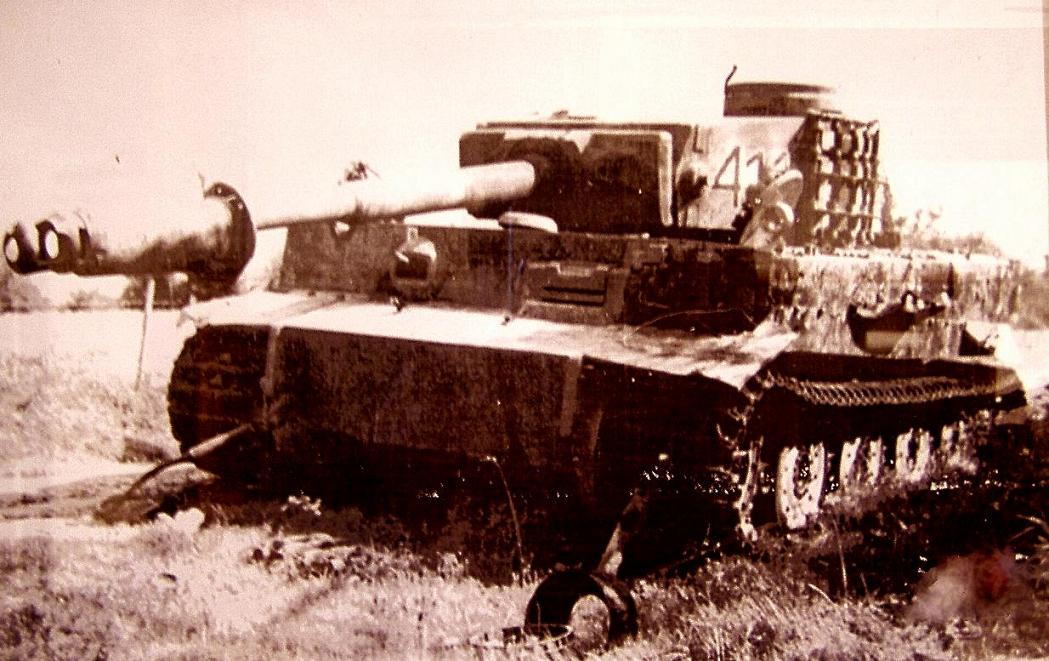
you recall about direct confrontations with tiger tanks, or the German tanks?
Bob Anderson: Well,
I’ll say this, when we first went into action we had what we called a
75-millimeter gun, and we might just as well have had a BB-gun. You actually
could shoot that 75-millimeter gun against a German tank and see the projectile
just jump off. Then finally we got what we called a 76, and that did penetrate.
And then a little later on they finally gave us a 90-millimeter. But the only way,
when we first went into action, is when we hit a German tank, you either hit
their tracks – we found this out – you either shoot for their tracks, or right
around the edge of the turret there’s a ring, do that. I think, too, that the
first time we were in action and our projectile hit a German tank, I would say
25 percent of the time the Germans were as scared as we were, just jumped out
of the tank thinking their guns were hit. Because really, I know, and the rest
of the people, them 75s weren’t worth a damn against the German tanks as far as
piercing, the armor-piercing. But after we got the 76 and then the
90-millimeter, then we had a chance. And I’ll give the Germans a lot of credit,
their tanks were diesel, where ours were gas, and a German tank was much more
quieter creeping up on us. Also, they would turn a lot shorter. We’d have to
take a, well, I’ll say just an acre of ground where they could turn around on a
dime. The Germans were way ahead of us at the start of the war, if they knew
it. But we had artillery and we had the superior air power, and we had a heck
of a good infantry, and that’s what did it. As far as the tanks, I don’t know
why they sent our tanks into Normandy, with the 75s after we had
been in Africa fighting. Patton should have known that them 75 guns were no
good against the German tanks. Now why that wasn’t down there, because Rommel,
they had enough tanks fighting down there, maybe they didn’t have 75s, maybe
they had good tanks in Africa.
Aaron Elson: Tell me
again about this photograph. This was a cow that...
Bob Anderson: Well,
I just went out and shot a cow, because I’d been on a farm and I’d butchered
and this and that. We wanted some steak.
Aaron Elson: What
would you normally eat when you were out in the field?
Bob Anderson:
Generally we had what we called C rations, that was a can of, oh, Spam and
crackers and that. And the first thing we did when we got into any homes or any
town or somewhere, why you’d grab the eggs. I had a lot of cases of eggs I lost
on the front. They had the eggs, the French people and the Germans would have
the eggs hid under the beds. You’d get the eggs.
Aaron Elson: What do
you mean by a lot of cases of eggs that you lost?
Bob Anderson: Well,
I’d find – not just me but all of us would find, what we did, was on the front
of these tanks we’d put a plank, and then we’d put things up there, and we had
eggs or something, and if you ever got back in a place like this you could fry
eggs. Then in the chimneys of a lot of places you’d find hams hanging up in
there. And then of course a lot of people would catch chickens and kill them
and cook them up. Generally when you were up on the line all you got to eat was
C rations, but then when you got back for a 10-day rest you’d do most anything.
Then there was one time a bunch of us guys was having fun, we’d throw these
hand grenades in the creek, of course they’d go off under water and we’d get
fish, clean the fish. Then we got crazy enough we was taking and unscrewing the
cap and knock all the powder out, and then we’d pull the pin and toss them over
to somebody. Well, they wouldn’t go off. Well, I did that to one kid whose name
was Bynum, I says, “Here, Quentin Bynum,” well, I didn’t have all the powder
off so the thing exploded. It didn’t have strength enough but that made us quit
doing that stuff. He could have got hit in the face or something.
Then another thing, when we were
back in bivouac area, they’d set up a shower out in the field, and they’d come
in with a big tanker truck of water and they’d set these showers up, and then
you’d go into a place and you’re in the field, and you lay your other clothes
there, and take a shower. And them Frenchmen would come in, especially the
women, and grab your clothes and away they’d run. And then another great thing,
what really got me, is maybe we’d be sitting out there and you’d dig a slit
trench, and women and girls and men and everything would come up and shake your
hand when you’re sitting on one. You know, it’s just different, comical things
like that that you remember.Like I say, I never got a, I came out of it very fortunate, and there were some good memories and that.
Aaron Elson: Ruby
Goldstein talked about taking the tank and digging up potatoes. Did you ever do
anything like that?
Bob Anderson: No, I
know what he could do, you probably could go down a potato row like this and
then pull a lever and the thing would just go like that and the potatoes would
come up. See, when we went from Swindon down to Southampton there in England,
this Colonel Whiteside Miller who later lost his rank, he was an oddball for
being a colonel, but we’d go around corners in towns, and when you went around
it you’d just tear up the curbing and everything. It cost the United States a
lot of money for that run. We had to blame Miller for it. If he’d have said you
have 15 hours to get down to Southampton instead of five or six hours, they
wouldn’t have drove and they wouldn’t have been there, I think out of
thirty-some tanks, I think six or seven tanks is all that made that run. The
rest of them broke down. Some tore the tracks off, some did this and that. Oh,
I’m telling you, that Whiteside Miller, he was something else.
Aaron Elson: Tell me
about him.
Bob Anderson: Oh, I
just knew him by his name. To me, he would have been a poor leader in combat.
After that, then they relieved him, we got Colonel Randolph, and he was all
right. And after Colonel Randolph got killed, Colonel Kedrovsky took over. I
really knew Colonel Kedrovsky better than anybody, he was a really good man.
Aaron Elson: What
was he like? What can you remember about him?
Bob Anderson: Well,
I can’t remember anything, he was just a good soldier.When he came back to the
United States, he worked at Sears and Roebuck stores, and he changed his name
from Colonel Kedrovsky to Kaye. He had a funny accent to his voice enough. But
like I say, I really liked that man, and I’ve got to say that he was a good
leader. And he stood behind his men. He didn’t criticize some man or run him
down when he did something. Well, Dixon and I were talking about, he would come
up and ask for advice, even enlisted men. “Now, soldier, what would we do here?”
or something like that, and he’d go back and think about it. I didn’t get to
knowing Randolph that well.
Aaron Elson: What
was the longest stretch that you ever spent inside a tank without getting out?
Bob Anderson: Oh
heavens, I wouldn’t have any idea.
Aaron Elson: Did you
ever spend more than a day?
Bob Anderson: Oh,
yes. Well, now you’re saying getting out. There was times you’d get out and
take a piss, something like that. But no, you’d spend a day and maybe that
night sleeping on line, you’d sleep in the tank, but you’re talking about
getting out and walking around and that. Oh, I’d say maybe two days or three
days, but still you’d get out enough. Now Hagerty, he had a lot of, I don’t
know what his trouble was and he’d have a lot of accidents and they’d have to
bring him up clean shorts, you know, like that, whether he was too scared to
get out of the tank, but he was a good man and that.
Aaron Elson: He told
me a story that once you got out of the tank to take a piss, and everybody else
got out, and all of a sudden shooting broke out and you had to pile back into
the tank.
Bob Anderson: Yeah,
shooting started, and I’d say, yeah, there’d be a lot of times when you wouldn’t
be done with the job, and this and that. I wonder what his favorite saying was,
it was something like, “Send me up some clean underwear,” or something like
that. The biggest joke really with Hagerty is, he smoked, and every Lent he’d
quit smoking, then after Lent he’d start smoking. And then he’d say, “God, if I
could only quit that. I just wish I could quit smoking.” I said, “Well, Bob,
you just did for six or seven weeks.”
“Yeah, but that was Lent,” he said.
That was a big joke to me. Bob was a good man. I liked him, and like I say, I
got along fine with everybody in the service and I had a good time, and still I
wouldn’t want to go through it again.I had a lot more aftereffects after I got home.
Aaron Elson:
Describe those.
Bob Anderson: Well,
we lived a mile down the road here. I farmed for thirty years. And when I first
came home, there’d be nights say that I worked in the field late, I’d be scared
to go out to the barn to milk the cows because I knew there was Germans out
there waiting. So I’d drive up this road right here, I knew there was a German
tank, and my wife will bear that, there’d be nights I’d lay in bed and just
freeze like that, she’d wake me up, and I’d be, W-w-What’s the matter? “There’s
Germans there.” I had more aftereffects, and scareder, than I did when I was
over there. But I was scared, and every time after you were back on break, you’d
pray that you would never have to go back up to the line. And anybody, I always
said this, anybody that was in combat who wasn’t scared, they’re either a damn
liar or they never was in combat. That’s my opinion, my version of combat. If
you weren’t scared, you weren’t in combat.
Aaron Elson: Several
people have said that. Tony D’Arpino said “There’s scared and there’s yellow,
and they’re completely different.”
Bob Anderson: Well,
the yellowness is like I described Fowler, and Fowler admitted it, and he was a
soldier because he admitted it and got out of there, because what if you’d have
gone up there and you didn’t have a damn round, that’s what got me, if you didn’t
have a round of ammunition in your breech to fire, what protection did we have?
Aaron Elson: Did you
ever see a doctor or get counseling about the aftereffects?
Bob Anderson: No.
The only thing that I didn’t do when I got out of the service, I think when I
got home, is today I’m wearing hearing aids. If I take these off I’m stone
deaf. Well, when
I first got out, after a few years, I went to Iowa City, to a
veterans’ hospital, and they operated on my ear free of charge, but they said
if I would have filled out a petition when I first got out and got my
discharge, I’d have gotten free hearing aids every year. That’s the only thing
that I say that I did wrong. Of course, when I got back out of the service,
when I landed in New York, and got back to Fort Sheridan, “How many points do
you have, Soldier?” A hundred and thirty-five, I think it was, or 132. “What do
you want, a discharge or a 30-day furlough?” Well, all that was on my mind was
a discharge then. If I’d have taken my 30-day furlough I’d have got paid, then
I’d have went back in there and stayed there ten or fifteen days more and get
through that. But all I thought of was my discharge, so I got out on May 15,
1945, and I was out of the service. A lot of boys later, they took their 30-day
furlough and then they came back. That was another thing that’s over the river,
but I could have made some money there.

- - -