Showing posts with label Norman Rockwell. Show all posts

Monday, April 3, 2017

Heimboldshausen, April 3, 1945


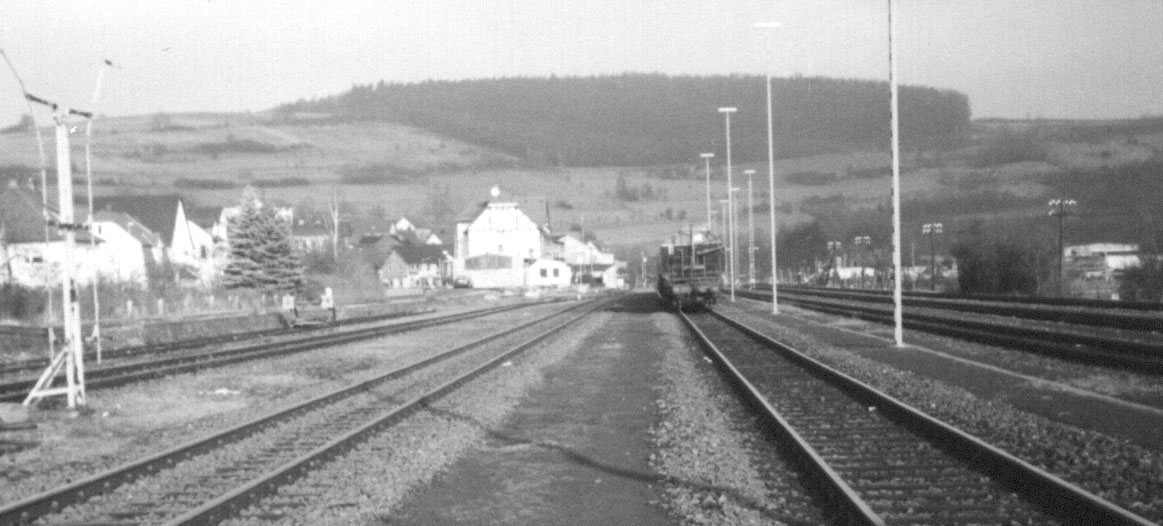
The railroad tracks at Heimboldshausen, April 4, 1945
I've never been big on birthdays or anniversaries. I'd probably forget it was my birthday if my four siblings didn't all call me and my sister Arleen Wiener didn't send me an annual card with a funny picture of a wiener dog on it or my colleagues Nancy and Erica didn't always remember to bring me a cake or some other confection. I've worked at one newspaper or another as a copy editor so many Thanksgivings and New Year's Eves and other holidays that now that Sunday is a regular day off I still don't get invited to Super Bowl or Academy Award watching parties because those traditional events started so long ago among my friends and colleagues that their rosters of invitees are pretty well set.

But give me an anniversary from World War II and fuhgeddaboudit. Seventy-two years ago today, on April 3, 1945, my father's 712th Tank Battalion, attached to the 90th Infantry Division, rolled into the village of Heimboldshausen on the west bank of the Werra River in Germany. Heimboldshausen never makes the lists of "This day in history" or even "This day in World War II," which is understandable because there were a thousand Heimboldshausens in World War II and there was only one Okinawa, for instance, where the invasion began on April 1 and there were other major events going on. But if there were a list of days that stand out in the history of the 712th Tank Battalion, April 3, 1945 would be right up there with July 10, the day Lt. Jim Flowers and his four tanks helped turn the tide of the weeklong battle for Hill 122 in Normandy or Jan. 9, 1945, when the battalion's beloved commander, Lt. Col. George B. Randolph, was killed at Nothum, Luxembourg, during the Battle of the Bulge, or Jan. 18 and 19, 1945, when the battalion's A Company withstood nine German counterattacks at Oberwampach, or March 16, 1945, when Lieutenant Snuffy Fuller had his worst day in combat, losing four men in his platoon killed in action at Pfaffenheck in the Rhine Moselle Triangle.

There was a firefight with some diehard SS troops on the way into Heimboldshausen but they were no match for the so-called "armored fist" of the 90th Division and the Germans retreated out the far side of the town, with the tanks and infantry in pursuit. It was late in the afternoon and the service troops of both the infantry and the tank battalion were billeted in the town overnight.
Heimboldshausen in 1999
 
There was a small railroad depot in the village. On one side of the tracks was a row of houses, while on the other was a wide open field with a copse of trees on a hill made from slag from a nearby potash mine off in the distance.

My father was not with the battalion at the time, having been wounded and evacuated at Dillingen in early December, just before the Battle of the Bulge. But Lt. Edward L. Forrest, who my father, a replacement, had bonded with, was the A Company executive officer. Ed was wounded in Normandy, at about the same time my dad received his first of two wounds, and returned in November, just in time for Dillingen and the Bulge.

As the executive officer, it was Ed Forrest's job to select houses in which to billet some 32 men of the battalion, which included cooks, mechanics, clerks, truck drivers and the crews of one or two disabled tanks. He set up his headquarters in the basement of a house opposite the railroad tracks.

A gasoline truck was parked outside the house, filled with rows of five-gallon jerry cans of fuel, some 250 jerry cans in all, although its driver, Joseph Fetsch of Baltimore, said he found a way to arrange the cans so the truck could carry 300 of the cans. The truck had a ring-mounted .50-caliber machine gun on the top. At about 6 p.m., two mechanics, Pete Borsenik and Steve Szirony, were standing in or near the doorway of the house when someone shouted "Plane!"

Here lies an "unbekannte flieger," or unknown flier, later identified as Erwin Bunk.
The plane was a Messerschmitt 109, flying low over the wide open field toward the village. Its mission was to attack a boxcar in the village's small railroad depot, not far from the house Forrest chose as his headquarters. There were several railroad cars at the depot. They included a half-dozen empty ore cars from the nearby mine, as well as a boxcar full of material for making uniforms and another boxcar which was full of bags of black powder for use in artillery shells. There also were gasoline tanker cars which were empty but were filled with fumes.

Joe Fetsch, the gasoline truck driver, climbed atop his truck and manned the .50-caliber machine gun but it was rusted into place and he couldn't turn it. The next thing he knew he woke up in a field hospital a day and a half later. Ervin Ullrich, a cook who was preparing a rare hot meal for the men, was killed in the explosion. Borsenik and Szirony were both seriously wounded. The house in which Ed Forrest had just set up his headquarters in the basement, collapsed, along with three nearby houses that sustained major damage. In all, five members of the tank battalion were killed, and of the 32 personnel in the village, only three were unhurt. The service personnel of the 90th Division sustained even greater casualties.

The battalion's unit history attributes the explosion to the carload of black powder, but it was more likely the fume-filled tanker cars that exploded, the same sort of explosion that was attributed to the 1996 crash of TWA Flight 800 into the Atlantic Ocean just off the coast of New York's Long Island. That would explain the lack of a fire and the fact that the gasoline didn't ignite, but rather it was the concussion that caused the extensive damage.

Four houses after the explosion.
The pilot of the Messerschmitt-109, was caught up in the explosion and crashed into a barn in the adjacent village. Harry Moody, a truck driver who was delivering supplies to the front but turned around when he heard the explosion and saw the plume of smoke, turned around and returned. He saw the wreckage of the plane in the barn, and recalled that all he could see of the pilot were his boots, which were still smoking.

I visited Heimboldshausen in 1999, and through the Internet lined up two German historians to meet me there. I hoped to find elderly villagers who remembered the explosion, but we only found one woman, Josephine Escher, who had celebrated her 19th birthday in one of the destroyed houses some months before the explosion. The house was rebuilt after the war. She gave me a snapshot of her standing on the balcony on her birthday.
Josephine Escher


I also found an elderly gentleman who had been in a German anti-aircraft unit who, with the war winding down, was released from his unit and returned home to Heimboldshausen, arriving a few days before the explosion. I asked him if anyybody had photos of the scene, and he said the Americans had confiscated all the cameras. So I left the village with copies of the photos taken by the soldiers that I had brought with me.

Ed Forrest grew up in Stockbridge, Mass., raised by an Episcopalian minister, the Rev. Edmund Randolph Laine, from the time he was 14. There was friction between the minister, who wanted to adopt Ed, and Ed's biological father. Before going overseas Ed proposed to his girlfriend, Dorothy Cooney, a seamstress, who never married and died in her nineties. The Norman Rockwell Museum used to show a video in which Dorothy can be seen riding a bicycle down Main Street. Ed's best friend, Dave Braman, who was a fighter pilot during the war, became the Stockbridge postmaster. Dave's wife, Ann Braman, posed as the schoolteacher in a famous Rockwell painting, and Dave's father, who ran a general store in town, posed as the village clerk in "The Marriage License," another Rockwell painting.

The Schoolteacher
Ed is buried in the American cemetery at Margraten, the Netherlands. In 2010, Carbooncollege, a school in the Netherlands, adopted his grave, and would decorate it with flowers and say a prayer for Ed during field trips to the cemetery. It's my understanding that due to budget constraints, the field trips are fewer and farther between if they are made at all. But the students and teachers put up a display about Ed's life in their school.

Teacher Wiel Goertzen and his family at Ed's grave


The display about Ed's life
In 1995, I interviewed Ed's brother, Elmer Forrest, and visited St. Paul's Episcopal Church on Main Street in Stockbridge. It was a Saturday and the church was empty, but I found Ed's name on an honor roll on a wall of the church, and I signed the guestbook in the front. A few days later I contacted the current pastor, who said he didn't know much about Edmund Laine but if I contacted the library, they had a diary that he left.

I immediately wondered what he wrote on April 3, 1945, the day Ed was killed. So I made an appointment with the town historian, who met me in the library's history room with the diary. This was the entry for the date:
"Eddie killed this day in action in Germany ..." It was added as a footnote because it would be 13 days before Reverend Laine learned of Ed's death.

I wound up photocopying the entire diary -- more of a daybook, really, with eight or nine lines for each of five years, from 1941 to 1945, on every page. That's 365 times 5 of entries like the one above, although not all of them are as crammed with information. The diary itself is a remarkable document of life in small town America during the war. But that's a project for another day.

Friday, November 15, 2013

December 8-14, 1941

Diary of Rev. Edmund Randolph Laine, Dec. 8, 1941
   Before I proceed with the journal of the Rev. Edmund Randolph Laine of St. Paul's Episcopal Church in Stockbridge, Mass., from 1941-45, it's important to note that Dorothy Cooney once told me the often crammed and clipped and abbreviated language of the journal doesn't do justice to Rev. Laine's eloquence. So I'll interject one passage here that was not in the journal, but rather was inscribed in a book that Laine gave to Ed Forrest's friend Dave Braman after Ed was killed in World War II. (Laine raised Ed from the time he was 14. Ed, whom my father knew in combat, was killed at Heimboldshausen, Germany, on April 3, 1945.)
   The book is a small, hardcover edition of the story "England to America" by Margaret Prescott Montague. The story was first published in the Atlantic Monthly and was the winner of the very first Ohenry Prize for short story writing in 1919.

- - -
 
   To David E. Braman,

   Dear Dave,

          This classic little story of the First War of 1917-1918, was a great favorite with Eddie. I gave it to him in 1929, and he read it many times. You and I can appreciate the truth, the grace and the poignancy of this narrative, since like Chev Sherwood, Eddie passed over, fighting gallantly for his country. Little did he think as he read it, that the years to come would call him to the same manly sacrifice. You were his beloved friend, keep this cherished book of his, in proud remembrance.
           From, Edmund Randolph Laine, June 21 - 1946. Stockbridge, Massachusetts.

- - -

   As you may have noticed, the minister's handwriting, especially toward the end of crowded entries, is a little difficult to read. Even in less crowded areas, the top of a 'd,' for instance, will jut up into the line above it, causing all manner of confusion. I'm not familiar with the names of many of the people he references, and so you'll see a lot of question marks where I was unable to make out what he was writing. Nevertheless, much of the important material in the journal -- who and what he was listening to on the radio, what newspapers, books and magazines he was reading -- are fairly legible. I will do my best from here on out to annotate, hyperlink and explain what some of those references are.

December 8, 1941


Dec. 8: (Monday) (cross symbol) (war declared, circled) Cold, sunny. Up 11, shaved (Radio - News, "Pepper Young's Family") 12:30 - while eating heard Pres. Roosevelt address Congress - War message - calling for declaration of war on Japan - over 12:45. Then broadcast of speeches in House of Representatives. 1:00 - News that Senate had voted dec. of war. Roll call in House of Rep. began 1:04. 1:14 - majority vote reached in House of Rep. 1:16 - news. Read "Times." 3 - Winston Churchill speaking at Parliament in London - over 3:22. Around grounds & walked down Main St. Mrs. Dixson(?) spoke to me. Talk with C.M. [Carlton Markham?] & gave him book. Read "Eagle." Began to read (?) . 6 - News. 10 - Pres. signed Dec. of War. 9 - Quincy Howe. E. read in study. 10 - R.G. Swing. Read in (?). 11 - News.

December 9, 1941
Dec. 9: (Tuesday) Fairly cold, gray, snowing some. Up 11, shaved, shower bath. Noon - News (Planes Raid to be near N.Y.)[this may be air raid duty] Mrs. W. Pitt Palmer phoned (going to hospital for operation on eyes to-morrow). 2:15 - left in car with C.M. for Springfield. Snowing but not too cold - arr. Diocesan House 3:40. 4 - Meeting of Adult Education Com. - talk with Fr. Butler about Farrell case afterward. Started home 6 - bad going on ladder - arrived 7:40. 8 - dinner. Read "Eagle." Read "Christian Century" & "Times." 9 - Quincy Howe. 9:30 - "Fibber McGee." 10 - Pres. Roosevelt addressing the people on the War (E. listened to it) over 10:25. Had bran muffin & apricots. 11 - News. Read in "Goethe & Schiller."

December 10, 1941
 

Dec. 10: (Wednesday) Cold, sunny. Up 11:10. Shaved (Noon - News). Rec'd book "Relig. Leaders of Am." - looked over it. To Bank. 2 - to Lee (Bank), to Pittsfield (Bank & ?) - to House of Mercy, saw Mrs. Russell Wilson of S. Lee (?) back 3:45. Made up some acc'ts. To Library - back 5:20. Looked over "Relig. Leaders of Am." 6 - News. Eve. - ans. a letter. 7:15 - Arthur Hale. 9 - Quincy Howe. Miss F. home. E. to see sister in Lee. Read "Times." & in Hayes' "Generation of Materialism." 10 - R.G. Swing. Had milk, apple & bran muffin. 11 - News. Read in Ludwig's "The Germans." (Christmas Appeals issued)

December 11, 1941


Dec. 11: (Germany & Italy declare war on U.S.) (Christmas Appeals issued) (War declared on Germany & Italy) Cold, sunny. Up 11:20. Noon - (over WEAF) from Wash. from Capitol heard news of Hitler's speech declaring war on U.S. - also Italy joins in! Heard vote in Senate declaring a war. 12:34 - heard Pres. Roosevelt's War message read in House of Reps. for Dec. of War - was passed. C.M. & Miss F. worked folding Christmas Appeals. I addressed envelopes (63 issued). C.M. mailed them - 2:30. Made out application & bot [bought] defense bond from Bank - E. did the business(?) for me. Wrote Sun. press notices. Grown very cold. Read Frat. mag. Read "Eagle." 4:25 - E. in, brot my defense bond. Read "Times" & news(?). Very cold. Eve. - read in Ludwig's "German." 8:30 p.m. E. to go to Award meeting. 9 - Quincy Howe. 10 - R.G. Swing. 11 - News. 4:15 a.m. - fire[false?] alarm. R.(?) phoned me by mistake.

December 12, 1941


Dec. 12: (Friday) Very cold, sunny. Up 11:20 (Noon - News), shaved. Some Appeal responses left at door. Ans. responses. 2:15 - Rev. J.V. Butler phoned from Springfield. To Bank. Read "Times." Miss Adams in. Changed clothes. To Library - left flower cheque in Derrick's with Mrs. (?). Took short walk. Phoned Dr. Kimberly. Wound clocks. 6 - to see Dr. Kimberly - he was out hunting for lost Dealey boy - came in 6:15. Conference with him about Geo.(?) Fallon - back 6:50. Eve. - wrote 2 letters (Fr. (?) Butler(?) & Dr. (?). Miss F. home. Read in Ludwig's "The Germans." Wrote note to Mrs. Thomas in N.J. 9 - Quincy Howe. To post office. Read in "The Germans." Had lamb sandwiches. 11 - News.

December 13, 1941


Dec. 13: (Saturday) Cold, snowing. Up 12:05, shaved. Radio - News. Read "Times." Joanna Franz phoned about evening party. Phoned Mrs. Sedgwick. 3:15 - to Jr. Choir Party in Parish House - home - 4:50. Read "Eagle." Ans. some Appeal responses. Picked out hymns. E. to Pittsfield - p.m. 6 - News. E. to Air Raid duty & then to Occ. Club. Read in Ludwig's "The Germans." Raining hard. 8:25 - into Young People's party in Par. House - talked with Mrs. Franz. Read on "Esther." Worked on sermon. Ate apple. 11 - News. Shower bath.


December 14, 1941

   Dec. 14: (Advent 3) Fairly cold, rained till 10 a.m. bad under foot. Up 7:35, shaved. Breakfast 8:35. 9:15 - S. Lee - Holy Com. - back 10:05. T. Burt* opened Sun. School. Spoke to children. 11 - Stockbridge - "Esther." (19 min.) Spoke of war. Cleared - a little subn. Read in "Times." 3 p.m. - N.Y. Symph. Orch. 4:30 - E. came & read "Times" in study. 4:30: Albert Spalding. 5 - Met. Opera Auditions. 5:45 - Wm. L. Shirer. Eve. - Miss F. to the Pillings - ans. some Appeal responses. E. read in Ludwig's "The Germans" in the study. 9 - Ford Hour (Richard Crooks). Read some stories in out Vol. Dumas. 10 - News

*T. Burt almost certainly was Tommy Burt, I'm guessing 16 or 17 years old at the time. The week that Ed Forrest was killed, but still before the telegraph arrived, Reverend Laine learned that Tommy Burt was killed "on the Western front," and paid a call on his grieving parents. Tommy's brother Jimmy Burt would be awarded the Medal of Honor for his actions during the battle for Aachen, Germany, in October of 1944.