Showing posts with label Heimboldshausen. Show all posts

Monday, December 24, 2018

A cemetery Christmas

Dutch History teacher Wiel Goertzen at the grave of Ed Forrest.


   At my office Christmas party, I mentioned to my colleague Bob Montgomery, an avid historian in the city of Bristol, Connecticut, that I’d like to give a talk at the Bristol Public Library. He asked me if I wanted to talk about my books. I said, “No, I’d like to talk about cemeteries.”

   I proceeded to tell him three stories about graves, and I was telling him a fourth when our publisher, Michael Schroeder, happened by and said, “Leave it to Aaron to talk about cemeteries at a Christmas party.”

   “Actually,” I said, “these stories are kind of uplifting.” I pointed out that the grave in the fourth story, that of an unknown German pilot, an “unbekannte flieger,” as it were, was marked by a propeller blade from the Messerschmitt 109 in which he crashed, and that a lady in the village cemetery at Heimboldshausen kept it decorated with dried flower arrangements even though she didn’t know his name. “Isn’t that kind of uplifting?” I asked. He wasn’t impressed.
The grave of the "unbekannte flieger" who, after my visit to Heimboldshausen, with the help of German historian Walter Hassenpflug, was identified as Erwin Bunk.
   But I’m getting ahead of myself. Bob said he always found cemetery stories interesting, as any historian would, so I told him that one of the stories I’d like to talk about was about Johnny Daum.
   In 1994, with the 50th anniversary of D-Day approaching, the newspaper I worked for at the time asked me to find some local D-Day veterans. So I wrote to Stephen Ambrose at the Eisenhower Center in New Orleans and asked for recommendations. He sent me a list of about a dozen.
   One of them was Ed Boccafogli, a veteran of the 82nd Airborne Division. Ed told of an incident that occurred before he boarded the plane to fly across the English Channel. There was a young paratrooper named Johnny Daum, and being that Ed was a little older and more rugged, he took Johnny under his wing. Johnny was about 19 years old, a good looking kid, tow-headed. Ed noticed Johnny staring off into space, and asked him if everything was okay.

   Johnny said matter of factly, “I’m gonna die tomorrow.”

I can still hear Ed quoting himself, ” ‘Ey, Johnny,'” he said, “‘some of us will, some of us won’t, you ain’t gonna be one of ’em.'”

   “Sure enough,” Ed said, “he was one of the first ones killed.”

   When I launched my web site tankbooks.com in 1997, I posted my full interview with Ed. Eventually the transcript of the interview was re-posted on the web site of the 508th Parachute Infantry Division, Ed’s unit, and the anecdote about Johnny Daum’s premonition was picked up in a book titled “The Americans at Normandy,” by John McManus.


   Meanwhile, in Eagle Lake, Wisconsin, a fellow named Tom Stumpner grew up knowing he had an Uncle Bud who was killed during the war. That was all he knew, as his mother would never talk about her brother.
    “Band of Brothers” was released in 2001. I don’t know when Tom saw it, probably not too long thereafter, and he suddenly remembered that his Uncle Bud was a paratrooper. His mother wouldn’t talk about it, but Tom’s interest in D-Day was piqued.

   Then his mother took ill. When she was near death, she gave Tom a box, I don’t know if it was a cigar box or a cardboard box, but in it were letters, snapshots, and other memorabilia from Uncle Bud. It was then he learned Bud wasn’t really his uncle’s name. His uncle’s name was John Daum.

   He didn’t know much beyond what was in the letters. But then he bought “The Americans at Normandy” and discovered the anecdote about Johnny Daum’s premonition. And then, I don’t know if he googled John Daum or Ed Boccafogli, but he discovered my interview on the paratroopers’ web site. He emailed the site and said he wanted to fill out his uncle’s story, and he sent them copies of the letters and snapshots his mother left him.

The American cemetery in Normandy. Photo by Mary Kay Bosshart.


   Fast forward to 2011. Mary Kay Bosshart, who writes a blog called “Out and About With Mary Kay,” took a tour of the American cemetery in Normandy. The tour guide stopped at one grave and told a story.

   In 2007, the guide said, another tour guide found a letter propped up against the cross marking the grave at which they were stopped. The grave was that of John Daum.

   The tour guide in 2011 gave Mary Kay a copy of the letter, which she posted on her blog.


Le 1 november 2007
Dear John,
    We don’t know each other, we know nothing of each other’s lives and even so, I feel I owe you so much. I know nothing of you or so little.
    I don’t know what were your tastes, your hobbies, your favorite music or if you had a girlfriend back home. I don’t know what you loved in life, your too short life.
    John, you’ve been buried here for over 60 years, in this land of France that saw your last days. These last days where you fought for the liberation of a country, a whole continent and a civilization. When I found your picture, I started thinking a lot about you, your face, your pink cheeks, almost the face of a child. Your smile tells me you must have been mischievous, cheerful and full of life.
    Then I felt a deep sorrow because I know that on that day of June 6 th, 1944, when you jumped into the cold black night on the Normandy beach, you must have been terrified. Terrified before the unknown, terrified at the thought of never seeing your family again, of loosing your army companions, of being alone, of death itself. Nevertheless, you survived that historic night and fought for two long days, before you fell on June 8 th.
    I wonder how were the last moments of your life, with who you were. From the bottom of my heart, I hope that you were not alone. Because I know that your comrade-in-arms must have done everything to protect you, reassure you and comfort you.
   
I read the letters that were addressed to your parents when you passed away and realized that you were very much appreciated by your army companions.
    Before I leave John, I would like to tell you how much I am aware that your ultimate sacrifice and the one of thousand of men like you has allowed me and all of us, to live in a land of freedom and peace.
    For all of this, I am sincerely grateful. So, I promise you that every time I will travel to Normandy, I will come visit you to honor your memory. I will lay my hand on your white cross, so that you are not alone in the dark anymore. I will keep your memory alive in my heart and I will never forget what you have done for me, for our liberty, for all of us.

    See you soon and may god bless you.
Yvan ----
Belgique
 

   Fascinated by the letter and wanting to know more about Johnny Daum, Mary Kay asked at the cemetery office if they could put her in touch with Yvan, and she asked the web master of the 508th PIR site if she could contact Tom.

   Today, Mary Kay, Tom and Yvan are great friends. Tom has been over to Normandy several times with members of his family, and has even learned a great deal more about his uncle’s experiences and the circumstances surrounding his death.


   The second story is about a Gold Star mother. It was told to me in 1999 by Erlyn Jensen, who was 12 years old when her brother Bill, who was 19, went into the service. Bill became a major in the 445th Bomb Group and was killed on Sept. 27, 1944.
   Erlyn's mother took Bill's loss very hard. Her two daughters encouraged her to join the Gold Star Mothers, which she did, and that seemed to help considerably. Then one day a family friend who Erlyn said wished to remain anonymous gave her mother an all expenses paid trip to France so she could visit her son's grave in the Lorraine American Cemetery at St. Avold.
    When she told the support group about the upcoming trip, one of the other Gold Star Mothers said, “Mrs. Mohr, I’ll never be able to go to St. Avold. If I give you ten dollars, would you buy some flowers and place them on my son’s grave?”

   “Oh, I’d be delighted to,” Erlyn’s mother said, or words to that effect.

   Now, this was a pretty emotional moment in the story and as often happens, I was getting choked up. Erlyn said, “If you’re gonna cry now, just you wait.”

   Erlyn’s mother went to France and visited the cemetery at St. Avold. She checked in at the office and a guide took her to her son’s grave. He gave her a whistle and said to blow it when she was ready to leave, and he would come and get her.

The Lorraine American Cemetery at St. Avold, France.
    She spent as much time as she needed, and then blew the whistle. When the guide returned, she showed him a piece of paper with the number of the other Gold Star Mother’s son’s grave.

The guide looked at the paper and said, “Mrs. Mohr, he’s buried right across the walkway from your son!” So she was able to come home and tell the other Gold Star Mother that your son and my son are neighbors.

   Over the years I’ve posted a lot of stories and transcripts from my interviews. On June 3, 2010, I received the following email:


Dear sir,
    My name is William Goertzen and I’m a teacher at a college for 12 till 17 year olds. I teach History and each year we spent about 10 weeks on World War Two. One of our fieldtrips is to Margraten, an American Burial site for soldiers killed in action; our school adopted the grave of one of these soldiers. With our classes we visit the grave once or twice a year, we pray for this man and we put some flowers at his grave in order to honor him and all those who died for the freedom of Europe and the Netherlands.
    Since October 2007 i have seen searching for information on Edward L. Forrest, 1Lt of the 712 th Tank Batallion. All I know is that he was killed in action on 3rd April 1945 and his ASN = O1017955. Now our idea is to make a wall inside the school with information and photos of Ed Forrest, so the War becomes ‘touchable’ for our pupils; it becomes more ‘real’ if they can look at and read about this lieutenant. We also hope to honor this particular soldier by creating this wall in our school, at
a place where pupils pass every hour/lesson.
    My problem is that I cannot seem to get any further on the internet. All trails lead to dead ends. I’ve sent forms with requests to the Department of the Army Administration section in Virginia, I’ve filled in a form of the NARA in Missouri, but no news yet. A mister Paul Wilson of North Carolina helped me on my way; Aparently Ed Forrest lived in Stockbridge, Berkshire County, MA., but all my internet searches lead to dead ends.
   In all of your interviews with veterans of 712th TB, I only once came across the name of 1LT Ed Forrest, mentioned by one of the veterans.
    Perhaps You could help me on my way, so I could learn more about his death but especially about the man behind the name; he also has or had family; I’d like to obtain information and pictures in order to make my remembrance wall and to use it in order to point out to 12 till 17 year olds that WW2 must never be forgotten.
    I hope to hear from you very soon and I would like to thank you already for reading my mail.
Yours sincerely
William Goertzen, teacher at Carbooncollege in the Netherlands.


   I didn’t know how to say “mother lode” in Dutch, but that is what Wiel had struck. Although my father’s time in combat was barely long enough to get a cup of coffee and two Purple Hearts, he managed to bond with a fellow lieutenant, Ed Forrest, who was killed near the very end of the war. As I recorded and preserved the stories of the veterans of my father’s battalion, I always asked veterans of my father's company about Ed Forrest. As Ed was an original member of the battalion while my father was a replacement, I heard many more stories about Ed than about my dad.

   And then in 1995, I decided to see if I could find Ed’s family. Within a couple of phone calls, I was on the line with Ed’s brother, Elmer Forrest. I went up to Lee, Massachusetts, and interviewed Elmer. I subsequently interviewed Dorothy Cooney, who had a secret romance with Ed and never married. I learned Ed had a falling out with his father and moved in with an Episcopalian minister when he was 14, and that the minister left a diary which I was able to read at the Stockbridge Library.

   Elmer Forrest had passed away, but I was able to put Wiel in touch with David Forrest, Elmer’s son, and David sent him a family photograph, which, along with some material I sent, was placed in a display case in the school.

The Ed Forrest display at Carbooncollege in the Netherlands.


   There you have it: three stories about cemeteries, each uplifting in its own special way, and each of which I had a role, however small, in preserving. If you’d like to know more about Johnny Daum, please visit the web site of the 508th Parachute Infantry Regiment.

   If you’d like to read or hear more, please explore the pages of my new web site, aaronelson.com, and check out the great prices in my eBay store.

Monday, April 3, 2017

Heimboldshausen, April 3, 1945


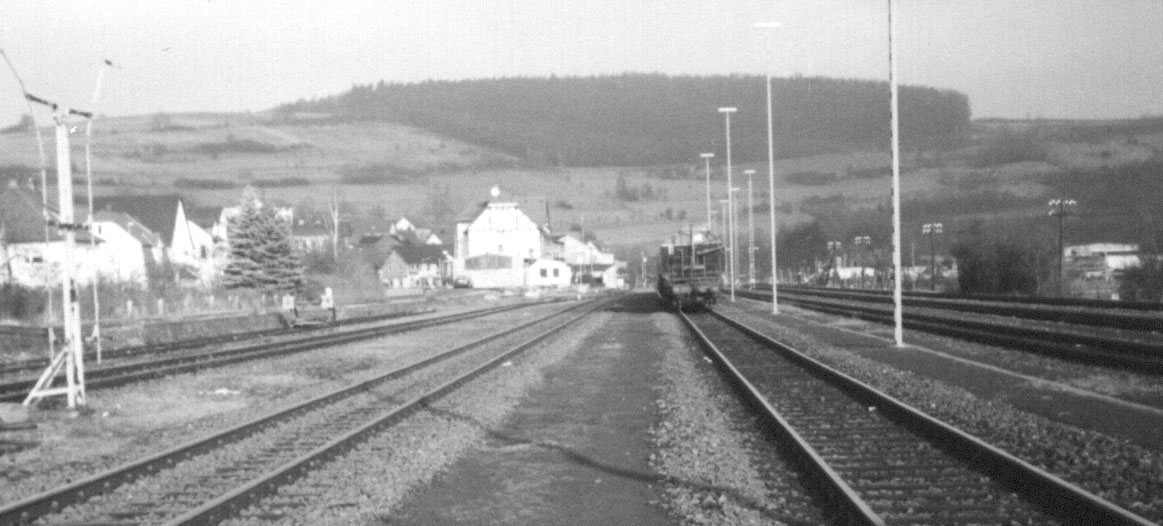
The railroad tracks at Heimboldshausen, April 4, 1945
I've never been big on birthdays or anniversaries. I'd probably forget it was my birthday if my four siblings didn't all call me and my sister Arleen Wiener didn't send me an annual card with a funny picture of a wiener dog on it or my colleagues Nancy and Erica didn't always remember to bring me a cake or some other confection. I've worked at one newspaper or another as a copy editor so many Thanksgivings and New Year's Eves and other holidays that now that Sunday is a regular day off I still don't get invited to Super Bowl or Academy Award watching parties because those traditional events started so long ago among my friends and colleagues that their rosters of invitees are pretty well set.

But give me an anniversary from World War II and fuhgeddaboudit. Seventy-two years ago today, on April 3, 1945, my father's 712th Tank Battalion, attached to the 90th Infantry Division, rolled into the village of Heimboldshausen on the west bank of the Werra River in Germany. Heimboldshausen never makes the lists of "This day in history" or even "This day in World War II," which is understandable because there were a thousand Heimboldshausens in World War II and there was only one Okinawa, for instance, where the invasion began on April 1 and there were other major events going on. But if there were a list of days that stand out in the history of the 712th Tank Battalion, April 3, 1945 would be right up there with July 10, the day Lt. Jim Flowers and his four tanks helped turn the tide of the weeklong battle for Hill 122 in Normandy or Jan. 9, 1945, when the battalion's beloved commander, Lt. Col. George B. Randolph, was killed at Nothum, Luxembourg, during the Battle of the Bulge, or Jan. 18 and 19, 1945, when the battalion's A Company withstood nine German counterattacks at Oberwampach, or March 16, 1945, when Lieutenant Snuffy Fuller had his worst day in combat, losing four men in his platoon killed in action at Pfaffenheck in the Rhine Moselle Triangle.

There was a firefight with some diehard SS troops on the way into Heimboldshausen but they were no match for the so-called "armored fist" of the 90th Division and the Germans retreated out the far side of the town, with the tanks and infantry in pursuit. It was late in the afternoon and the service troops of both the infantry and the tank battalion were billeted in the town overnight.

Heimboldshausen in 1999
 
There was a small railroad depot in the village. On one side of the tracks was a row of houses, while on the other was a wide open field with a copse of trees on a hill made from slag from a nearby potash mine off in the distance.

My father was not with the battalion at the time, having been wounded and evacuated at Dillingen in early December, just before the Battle of the Bulge. But Lt. Edward L. Forrest, who my father, a replacement, had bonded with, was the A Company executive officer. Ed was wounded in Normandy, at about the same time my dad received his first of two wounds, and returned in November, just in time for Dillingen and the Bulge.

As the executive officer, it was Ed Forrest's job to select houses in which to billet some 32 men of the battalion, which included cooks, mechanics, clerks, truck drivers and the crews of one or two disabled tanks. He set up his headquarters in the basement of a house opposite the railroad tracks.

A gasoline truck was parked outside the house, filled with rows of five-gallon jerry cans of fuel, some 250 jerry cans in all, although its driver, Joseph Fetsch of Baltimore, said he found a way to arrange the cans so the truck could carry 300 of the cans. The truck had a ring-mounted .50-caliber machine gun on the top. At about 6 p.m., two mechanics, Pete Borsenik and Steve Szirony, were standing in or near the doorway of the house when someone shouted "Plane!"

Here lies an "unbekannte flieger," or unknown flier, later identified as Erwin Bunk.
The plane was a Messerschmitt 109, flying low over the wide open field toward the village. Its mission was to attack a boxcar in the village's small railroad depot, not far from the house Forrest chose as his headquarters. There were several railroad cars at the depot. They included a half-dozen empty ore cars from the nearby mine, as well as a boxcar full of material for making uniforms and another boxcar which was full of bags of black powder for use in artillery shells. There also were gasoline tanker cars which were empty but were filled with fumes.

Joe Fetsch, the gasoline truck driver, climbed atop his truck and manned the .50-caliber machine gun but it was rusted into place and he couldn't turn it. The next thing he knew he woke up in a field hospital a day and a half later. Ervin Ullrich, a cook who was preparing a rare hot meal for the men, was killed in the explosion. Borsenik and Szirony were both seriously wounded. The house in which Ed Forrest had just set up his headquarters in the basement, collapsed, along with three nearby houses that sustained major damage. In all, five members of the tank battalion were killed, and of the 32 personnel in the village, only three were unhurt. The service personnel of the 90th Division sustained even greater casualties.

The battalion's unit history attributes the explosion to the carload of black powder, but it was more likely the fume-filled tanker cars that exploded, the same sort of explosion that was attributed to the 1996 crash of TWA Flight 800 into the Atlantic Ocean just off the coast of New York's Long Island. That would explain the lack of a fire and the fact that the gasoline didn't ignite, but rather it was the concussion that caused the extensive damage.

Four houses after the explosion.
The pilot of the Messerschmitt-109, was caught up in the explosion and crashed into a barn in the adjacent village. Harry Moody, a truck driver who was delivering supplies to the front but turned around when he heard the explosion and saw the plume of smoke, turned around and returned. He saw the wreckage of the plane in the barn, and recalled that all he could see of the pilot were his boots, which were still smoking.

I visited Heimboldshausen in 1999, and through the Internet lined up two German historians to meet me there. I hoped to find elderly villagers who remembered the explosion, but we only found one woman, Josephine Escher, who had celebrated her 19th birthday in one of the destroyed houses some months before the explosion. The house was rebuilt after the war. She gave me a snapshot of her standing on the balcony on her birthday.
Josephine Escher


I also found an elderly gentleman who had been in a German anti-aircraft unit who, with the war winding down, was released from his unit and returned home to Heimboldshausen, arriving a few days before the explosion. I asked him if anyybody had photos of the scene, and he said the Americans had confiscated all the cameras. So I left the village with copies of the photos taken by the soldiers that I had brought with me.

Ed Forrest grew up in Stockbridge, Mass., raised by an Episcopalian minister, the Rev. Edmund Randolph Laine, from the time he was 14. There was friction between the minister, who wanted to adopt Ed, and Ed's biological father. Before going overseas Ed proposed to his girlfriend, Dorothy Cooney, a seamstress, who never married and died in her nineties. The Norman Rockwell Museum used to show a video in which Dorothy can be seen riding a bicycle down Main Street. Ed's best friend, Dave Braman, who was a fighter pilot during the war, became the Stockbridge postmaster. Dave's wife, Ann Braman, posed as the schoolteacher in a famous Rockwell painting, and Dave's father, who ran a general store in town, posed as the village clerk in "The Marriage License," another Rockwell painting.

The Schoolteacher
Ed is buried in the American cemetery at Margraten, the Netherlands. In 2010, Carbooncollege, a school in the Netherlands, adopted his grave, and would decorate it with flowers and say a prayer for Ed during field trips to the cemetery. It's my understanding that due to budget constraints, the field trips are fewer and farther between if they are made at all. But the students and teachers put up a display about Ed's life in their school.

Teacher Wiel Goertzen and his family at Ed's grave


The display about Ed's life
In 1995, I interviewed Ed's brother, Elmer Forrest, and visited St. Paul's Episcopal Church on Main Street in Stockbridge. It was a Saturday and the church was empty, but I found Ed's name on an honor roll on a wall of the church, and I signed the guestbook in the front. A few days later I contacted the current pastor, who said he didn't know much about Edmund Laine but if I contacted the library, they had a diary that he left.

I immediately wondered what he wrote on April 3, 1945, the day Ed was killed. So I made an appointment with the town historian, who met me in the library's history room with the diary. This was the entry for the date:
"Eddie killed this day in action in Germany ..." It was added as a footnote because it would be 13 days before Reverend Laine learned of Ed's death.

I wound up photocopying the entire diary -- more of a daybook, really, with eight or nine lines for each of five years, from 1941 to 1945, on every page. That's 365 times 5 of entries like the one above, although not all of them are as crammed with information. The diary itself is a remarkable document of life in small town America during the war. But that's a project for another day.

Saturday, December 31, 2016

Happy New Year from Oral History Audiobooks

The Rev. Edmund Randolph Laine


   One of my New Year's Resolutions is to advance my transcription and preservation of the diary of the Rev. Edmund Randolph Laine, pastor of St. Paul's Episcopal Church in Stockbridge, Mass., during the World War II years. Laine raised Ed Forrest, who was killed on April 3, 1945. Ed was a buddy of my father in combat, and in researching Ed's life back in 1995 I learned of the existence of Laine's diary, which the Stockbridge Library allowed me to photocopy.
   As 2016 came to a close, I thought I might be able to find something appropriate in my archives, but a search of the phrase "new year" on my hard drive only brought up an excerpt from an interview with tank driver Tony D'Arpino, who described a furlough he received at Christmastime in 1943. When he left he was in the 11th Armored Regiment of the 10th Armored Division, and when he took a cab back to his barracks ten days later the sign out front said C Company, 712th Tank Battalion. Unbeknownst to him, the battalion had been taken out of the division and renamed as a separate, independent tank battalion. He was a bit confused, to say the least.
   And then I remembered that a few years back I began scanning and transcribing some of the entries from Laine's diary, so I thought, I wonder what he said on various New Year's Days. I have not yet scanned the entry from Jan. 1, 1945. Ed was still alive and about to take part in the Battle of the Bulge. Following is a loose transcript of the entry for that date (you would understand why I say "loose" transcript if you could see Laine's handwriting).


Monday, Jan. 1, 1945: A very warm day - 52 degrees at noon - raining hard - very dark. Up 9:20, shaved. Radio - music (WQXR) & News). 10:25 - breakfast. Package from Springfield. 11 - Holy Com. (17) - service men & women prayed for by name. 1:45 - helped Miss F. put guest room in order. Put Christmas tree & Christmas picture away. Wrote V-mail letter to E. (No. 981). 2 - Mr. Kingdon called - father died. 2:10 - to P.O. Read "Times." Read "Times." 3 - had tomato soup, turkey sandwiches & peaches. 3:30 - "Pepper Young's Family." Raining very hard. Rec'd END. Read in "Yankee Lawyer." ("Ephraim Tutt") Dozed in chair. Read "Eagle." Read in "Yankee Lawyer." 6 - News - Quincy Howe & Bill Costello. Storming hard. Read in "Yankee Lawyer." Radio music. Snowing. 10 - News - Henry Gladstone. Had hot milk, toast & baked apple. 11 - News - John Daly & William L. Shirer.

   Like many of the entries in the diary, this excerpt is full of little historical treasures. Take the line, "Read in "Yankee Lawyer" ("Ephraim Tutt."). I admit I had never heard of Ephraim Tutt, so I asked my friend Mr. Google. Who knew that only a few years ago a book would have been written about Ephraim Tutt.


   Here's an article about the book: The Myth of Ephraim Tutt

   Ed Forrest was killed at Heimboldshausen, Germany, on April 3, 1945. It was curiosity about what Laine wrote in the entry for that day that inspired me to begin reading his journal. I have scanned that entry. Note the thick black cross at the beginning and what appears to be an underlined footnote at the end saying "Eddie killed this day in Germany at about 12 p.m. our time." With the time difference of about six hours, it was just about dusk in Germany when a German ME-109 fighter plane attacked some railroad cars, two of which were empty but fume filled gasoline tankers, setting off a huge explosion just as Ed, his company's executive officer, was setting up his headquarters in the basement of a nearby house.

    The reason his death is recorded in the diary as a footnote is because it would be 13 days before Rev. Laine learned of Ed's death, and the entry was already pretty full, not to mention that with several lines for each of five years on a page beginning in 1941, the entry for 1945 was already at the bottom of the page.
   Well, it's almost midnight. I have to make some phone calls and start wishing close friends and relatives a Happy New Year. So I'll close by saying "Happy New Year" to all my Oral History Audiobooks aficionados and thank you for your interest in these remarkable bits of history.

Tuesday, February 25, 2014

My Monuments Men, Part 2


The 712th Tank Bn. entering Malybor, Czechoslovakia

 (My Monuments Men, Part 1)
   Harlo J. "Jack" Sheppard was the company commander of C Company, 712th Tank Battalion, from Normandy until the end of the war in Europe. Following is an excerpt from my 1993 interview with Sheppard in which he talks about the Merkers salt mine, among other things. The battalion was assigned to guard the salt mine, which is depicted in the movie "Monuments Men," following its discovery on April 4, 1945.
   The guarding of the mine, incidentally, was sandwiched between two other major events in the battalion's history: the explosion that demolished the A Company headquarters on April 3rd, killing five members of the battalion, including Lt. Edward L. Forrest; and the liberation of the Flossenburg concentration camp by the 90th Infantry Division, to which the 712th was attached, on April 23rd.
   Part of my interview with Sheppard consisted of me reading from a narrative he wrote for his children and grandchildren, with occasional comments he made elaborating on what he wrote.
   I have not yet finished transcribing the interview, having stopped about halfway through to move on to complete writing a book in which I used a narrative drawn from that first half of the interview. I recently made an audiobook of the full interview, "Reflections of a Tank Company Commander." Following is a transcription of Track 39 from that audiobook:

   Aaron Elson (reading from Jack Sheppard's book: "On 4 April near Ettenhausen, first platoon lost one tank to a panzerfaust ..."

   Jack Sheppard: Do you know what a panzerfaust is?

   Aaron Elson: Yes.

   Jack Sheppard: Okay, it's not a bazooka.

   Aaron Elson: It's a self-propelled ...

   Jack Sheppard: It has a charge in it, and it goes about 100 feet at the most. You stand up and you push the trigger and it goes. It's like a football coming at you. It's about the size of a football, with a stick out the back of it, and the stick is a tube that has the propellant in it. They come out of cellar windows, second story windows, haystacks, foxholes. If they hit the side of a tank it penetrates. If you're lucky it would hit down around the track. In Berlin they had Hitler jugend, Hitler youths, and that's all they had, every one of them, to give their life for one tank, that's what was expected of them, when the Russians came in. Fourteen years old, ten years old.

   Aaron Elson: (reading) "After the one tank was lost to a panzerfaust, second platoon lost two tanks to panzerfausts. No wounded. Seventeen prisoners were taken. Merkers. C Company and 357 were busy guarding a salt mine found by a German-speaking MP who overheard some women talking about a salt mine loaded with money. Gold, silver, priceless paintings, etc. Every brass officer from Eisenhower on down came to look. The GIs were used to bring the stuff to the surface and truck it away. Officers were used as guards ..."

   Jack Sheppard: To keep the enlisted men from stealing it.

   Aaron Elson: What do you remember about that?

   Jack Sheppard: Well, there was one battalion of infantry and my tank company left there to guard that. I don't remember a whole lot about it because they didn't bother the company commanders, but everybody and their brother went down in that mine to look at the stuff. I don't know of anybody that got away with anything, although one tank crewman, I can't remember who it was, later said some infantryman said to him, "Hey, Mac, can you give me a ride with this bag of gold? It's getting awful heavy." But the paintings, oh my goodness, all kinds of famous paintings. And money. They had everything there, from counterfeit English pounds and counterfeit American money, real American money, real English money, German money, silver coins. That was their main stockpile. That took several days, and it was kind of a vacation because nobody was shooting at you."

   Aaron Elson: (reading) "On 16 April we arrived at Grafenthal and a distance of 100 miles. Next day 20 miles. Next 12 miles, next 25 miles ..." You were moving.

   Jack Sheppard: Yes.

   Aaron Elson: Where was it that C Company liberated the prisoners from the 106th Infantry Division from the Bulge? Do you remember that?

   Jack Sheppard: No. The 90th ran into one of the extermination camps. I never saw it. All I saw was two men on the side of the road, and they looked like they couldn't hardly make it. So we stopped and we heard about this stuff when we stopped, and gave them some food and told them not to eat it too fast or it would make them sick. And they told a little story of two Germans they saw beaten to death. One of them was a sergeant in charge of the dogs and the other one was the first sergeant of the camp, and the prisoners beat them to death. And they said that they hated to admit it, but those two guys stood there at attention until they were knocked to the ground. Didn't cower and didn't ask for mercy, nothing. They knew they were gonna die, evidently.

   Aaron Elson: (reading) "4 May. C Company together with 357 in Corps reserve. 5 May crossed border into Czechoslovakia." When was VE Day?

   Jack Sheppard: A little later on.

   Aaron Elson: (reading): "Forty miles. Next day 20 miles, next 25 miles. 8 May holding in place at Malybor where C Company released from 357 as the war was over. At Malybor you never saw such happy people. They gave us a flag which is now in storage at the Patton Museum at Fort Knox. The flag said in Czech "Thank you for our liberation, Malybor." The volunteer fire department helped wash our tanks with hoses. A dance with music was held that night. The town was small, one or two hundred people. In a few days the order was given for us to move to Amberg, Germany." At Malybor I think Rossi said they put up a Maypole?

   Jack Sheppard: I've got a picture of it. At the entrance to the town they had an archway with flowers and leaves, and there was one girl in that town the men couldn't keep their eye off, she was always coming down to the river to wash clothes. She was a gorgeous blonde. The men hadn't seen a gorgeous blonde in a long time. She attracted attention. But those people were most happy. As soon as we got there they started digging up arms and ammunition that they had buried in case they ever needed them, and they were overjoyed. They couldn't do enough for us. They baked a cake for us, and they didn't have anything to bake cakes with. They said they were glad the Americans were there. They said the Germans, when they ride down the street they kill chickens, and ducks, and pigs, but the Americans, they look out for the animals, they wouldn't run over them. When they found out the Russians were coming in, they hated Russians worse than the Germans I think. They didn't want the Russians. No way. They were pleading.

   Aaron Elson: (reading) "In a few days the order was given for us to move to Amberg, Germany as the Russians were to take over Czechoslovakia. People were most unhappy. 15 May, moved to Amberg in two battalion columns, distance 130 miles." In one day you covered 130 miles?

   Jack Sheppard: Yes.

   Aaron Elson: (reading) "C Company arrived with all vehicles. Some were on their last legs..."0

   Jack Sheppard: I'm talking about blowing tread off the bogeys.

  Aaron Elson: (reading) "...and some were limping along, but C Company pulled into the tank park parking area complete. On long marches the rubber or steel tracks, we had both, generated so much heat the rubber tread of the road wheels would explode and come off of the steel wheels. Now to sweat out Japan for division. POWs evacuated, 81,088; tanks destroyed, 501; self-propelled guns destroyed, 195."
   And here are some excerpts from my interviews with other veterans of the 712th:
   Big Andy (Bob Anderson, tank driver, A Company): The most important thing that I remember after the Battle of the Bulge was when we took this Merkers mine. I was the first tank in there; I won't say the infantry wasn't, but I was the first tank in there, driving the first tank. And as we pulled in there there was a train leaving. And my gunner, Ted Duskin, of course the train was going fast, so we started running alongside and trying to catch it, and Duskin put a shell right in the engine and blew it up. Well, we pulled back to the mine and we sat there until I don't know how long or what. Not knowing what was in it. We didn't know for two or three days after how wealthy some of us could have been.

   Bob Rossi (loader, C Company): When we captured the salt mine at Merkers, I was on guard duty there, just before dusk, and these German planes were coming in to strafe. And I'm up on the turret there and I'm on the .50, and I'm firing, in fact they taught us in basic training you took a five to seven-plane lead ahead, so the plane's here, you're firing there, so that by the time the bullet gets there the plane would be there. And I'm firing away and I knew damn well I was gonna hit him, the damn round jumped out of the webbed belt. And by the time I could recover to reload, he was gone. I used to complain to the guys that brought our ammo, "I don't want the webbed belts, I want the metallic link," the metallic link held the round in there, but that webbed belt, the constant vibration of the tanks moving would loosen the ammo.

   Reuben "Ruby" Goldstein (tank commander, A Company):  Now, when we were at the mine, remember the Merkers salt mine? And we surrounded, all the tanks were around, there was an open field in the back, and McCarthy, from Connecticut, he worked in the kitchen crew, and he was put on guard duty. Now Alfonse Switer, he was the company cook, and he had to go to the bathroom. So he went. McCarthy thought the Germans were coming across the field. It's dark. I was upstairs in the mine building, on the third floor. I had my shoes off, I had my clothes on, I had my .45 and my submachine gun with me. And I hear shots. I come running, everybody, running like crazy, you know, you think something's happening. I come running down, and Al is hollering "Goldie, Goldie, help me, help me." And everything else is quiet. There's no more shots.
   McCarthy thought it was the Germans coming and he shot his carbine. In the leg. But he did not know that it was one of our own men. It was what you call friendly fire. Accidental. All right. So they took Al away, and nobody ever saw him again. And the reason they never saw him, because nobody knows what ever happened to him after that. Till the beginning of January of 1946. My brother and I, we bought a second-hand car, and my mother and I, and my brother Mel, he got out of the service after I did. My other brother came out after that. We picked up my aunt in New York and went to Florida.
   On the way back from Florida we stopped in Pennsylvania. We stopped at a gas station to gas up, and I said, "Why don't I call Al's house." He lived in Manionk. I was there in his house once, on my way back from a furlough I left a day earlier and went to the train station in Philly and Al's sister picked me up at the station. Al was supposed to meet me, but he wasn't there.
   I got to the train station, I'm looking around, I don't see anybody. A beautiful looking girl comes over to me, and she says, "Are you Goldie?"
   I said yes. I said "You must be Al's sister."
   She said, "Yes I am. I'm looking for you. He told me to bring you down."
   I said, "Bring me where?"
   She said, "He's waiting." And where was it? He was in a barroom, sitting at the bar, drinking. And another fellow, a friend of his, an insurance broker, with no legs. He had a little cart on the floor with wheels, just like with roller skates. And he was drinking. She left. And we had a few drinks. These guys were loaded.

   Now we're gonna go back to Al's house, he and I. This guy's gonna drive. This insurance fellow without the legs. But he had all the attachments. I says, "No way. I'll drive."
   "'You don't know...'"
   "I'm driving." I get them in the car and we drove to Al's house. He conked out in the car, the fellow without the legs, fell asleep, and I went up in Al's house, and we stayed there. The next day we had a ball, Al and I. We had a good time over in Conshohocken, at a Polish dance.
   But anyway, to get back to the story about when he got shot, and when I'm coming back from Florida, I get in the phone booth, and my mother and my aunt and my brother are sitting in the car. And I called up information, I get the number, and I don't know how to say it, to ask for him, I don't know if he's dead or alive. So I got the number, and I asked if this is the Switer residence, and this girl answered, and it was the same girl, his sister. So I told her, "Oh, my god," she says, "how nice to hear from you." You know, she sounded so happy. And all of a sudden, she said "Would you like to talk to Al?" Well, I nearly flipped. I never. He was there. I got on the phone, he says, "You S.B.," he says, "I thought you were dead." I says "I got news for you, I thought you were dead."
   I says "Nobody's ever heard from you." He was in so many hospitals, he had 26 operations, and his leg was gone all the way. Gangrene had set in. They made him artificial legs, and at first he was walking with the artificial legs with crutches, and then with a cane, and then he could walk on his own. I found that out, we went to a Polish dance one night, and he was dancing with an artificial leg as good as anybody.
   After I talked to him, that was the last I heard of him is when I talked to him on the phone. But he married this girl he was going with for fifteen years before he went in the service, and he finally married her when he came home. They had a home in Plymouth Meeting, in Pennsylvania, not far from Manionk.
   So I got married in 1949, and we went on our honeymoon to Atlantic City. We stayed eleven days, at the Senator Hotel at the time, it was the next street over from where the Resorts International is now. And I says to my wife, "Gee, let's go see if we can find Al." So what we do, and sure enough, I find out where he lives, I called the house where his folks live, and they told me where, and I went down to his house, and there was an open porch like a deck in front of the house. The two of us sat, it was hot as a sonofagun, it was toward the end of June. And they weren't home. They were both working. She worked in the offices of a coal company. And he worked for a clothing company, a very well-known name. He worked for them in the factory.
   Anyway, they came home, and the two of us were still waiting, I wasn't going to leave. They were so happy to see us. I'd met Mary before that, my wife hadn't met either of them. And we stayed, and he gave me his room.
   Anyway, he was a hot ticket. But always, anything, that's the way he was. Even in civilian life as well as in the service.

   (That last part doesn't have a heck of a lot to do with the Merkers salt mine other than that poor Alfonse Switer lost his leg after being wounded by friendly fire. I kept it in because Ruby Goldstein, who passed away a few years ago, was such a wonderful storyteller.)

Visit the Oral History Store

Jack Sheppard
Reuben Goldstein
Big Andy